Best Bed Frames for Latex Mattresses: Slats, Support & Fit
A latex mattress needs a frame that supports its full surface evenly, but the most useful details are often buried below a frame’s style photos. Slat gaps, the width of the slats and the way the middle reaches the floor can all change whether a platform is a good match.
The best bed frame for a latex mattress starts with the mattress maker’s support rules. Some models allow closely spaced slats; others call for a solid surface. A high advertised weight capacity does not answer either question.
We compare four distinct options below: a budget Queen platform, an unfinished wood Queen, a low Twin frame and a powered Queen base. Our picks focus on the support details that help you narrow the choice, with a clear explanation of who should skip each one.
Our Top Bed Frames for Latex Mattresses
Start with the size and support arrangement. These are frame-only selections; mattresses and bedding are separate.
| Product | Best For | Deciding Detail | Main Tradeoff | Skip If |
|---|---|---|---|---|
| ZINUS Parker — Queen | Best Budget | 2.4–2.8″ listed slat-gap range | Parker-only headboard attachment | You need a solid deck or a confirmed minimum slat width. |
| KD Frames Nomad — Queen | Best Unfinished Wood Frame | 2.8″ gaps; no center floor legs | Four floor legs; unfinished wood | Your mattress requires more floor-contact legs. |
| KD Frames Ekko — Twin | Best Low Wood Frame for Twin | 10″ platform; 3″ slat gaps | Twin configuration in this comparison | You need Queen size or gaps under 3″. |
| LUCID L600 — Queen | Best Adjustable Option | Articulating upholstered panel deck | Powered mechanism and higher cost | Your mattress is not approved for adjustable bases. |
Swipe the table to compare all five columns.
Three Checks Before You Choose
- Read the rule for your exact mattress. Record the permitted support surface, maximum gap, any minimum slat width and required floor-contact legs.
- Match the size and version. A Full and Queen from the same frame family can use different slat spacing. The product heading and linked size below identify the configuration we compare.
- Choose fixed or adjustable support. A fixed platform holds the mattress flat. A powered base bends it, so the mattress must be approved for that movement.
If your mattress needs a solid deck, begin with that requirement. Do not choose a slatted frame on its weight rating alone, then assume an extra board will make the combination suitable.
1. ZINUS Parker — Queen
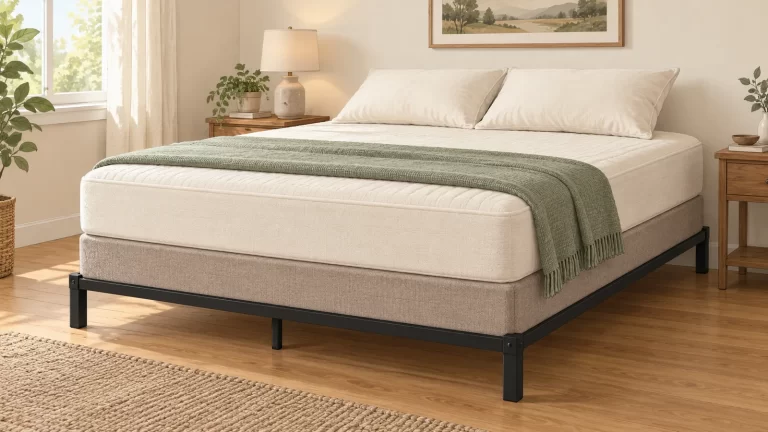
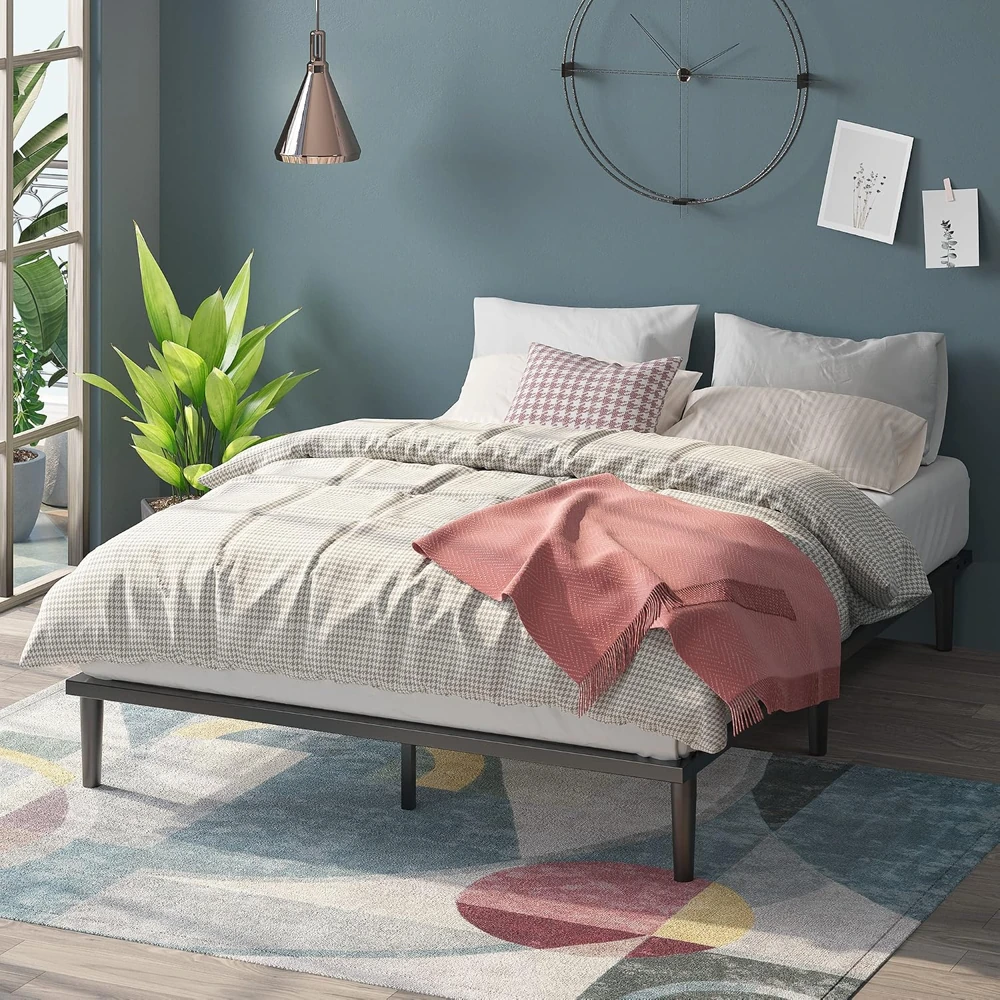
We would choose the Parker Queen for a lower-cost platform with a published sub-3-inch slat-gap range and floor-supported center structure.
Key Details
- Selected configuration
- Queen · black · tapered steel legs
- Support surface and gap
- Plywood slats · listed gaps 2.4–2.8″; slat width needs confirmation for mattresses that specify it.
- Center support
- Center beam with 3 center floor legs; linked assembly drawing shows 9 legs in total.
- Platform height
- 10″ before adding the mattress
- Listed load limit
- 700 lb for the selected Queen
- Box spring and extras
- No box spring needed when the slats meet your mattress rules. Mattress and Parker headboard are separate.
Why We Picked It
The Parker puts our budget toward the support structure rather than an upholstered headboard. Its wood slats have a published 2.4–2.8-inch spacing range, and the linked assembly manual shows a center beam with three legs reaching the floor. That makes it a useful starting point for a Queen latex mattress that permits gaps of up to 3 inches.
It was the least expensive of our shortlisted Queen configurations when we compared current new offers. We also like the 10-inch platform for keeping the finished bed lower: a 12-inch mattress would put its top approximately 22 inches from the floor. The headboard connection is the main styling limitation. ZINUS specifies Parker headboards, so we would not buy it expecting a generic bolt-on headboard to fit.
Pros
- Published slat-gap range stays below 3 inches.
- Three center floor legs support the middle beam.
- Lower-cost Queen choice with a 10-inch platform.
Cons
- Headboard attachment is specific to the Parker system.
- Minimum slat-width requirements need a separate check.
Who Should Skip This
Skip the Parker if your mattress requires a continuous deck or a particular slat width you cannot confirm. If unfinished wood and more side-rail storage clearance matter more than price, compare the Nomad Queen, provided its four-leg structure fits your mattress requirements.
2. KD Frames Nomad — Queen
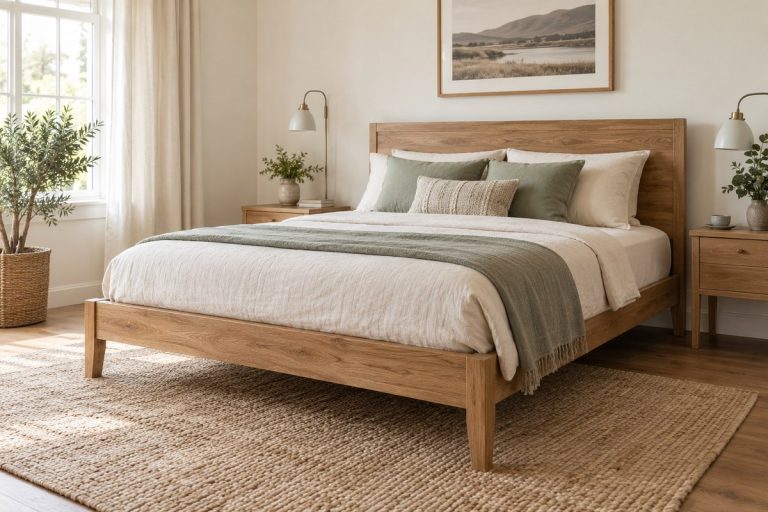
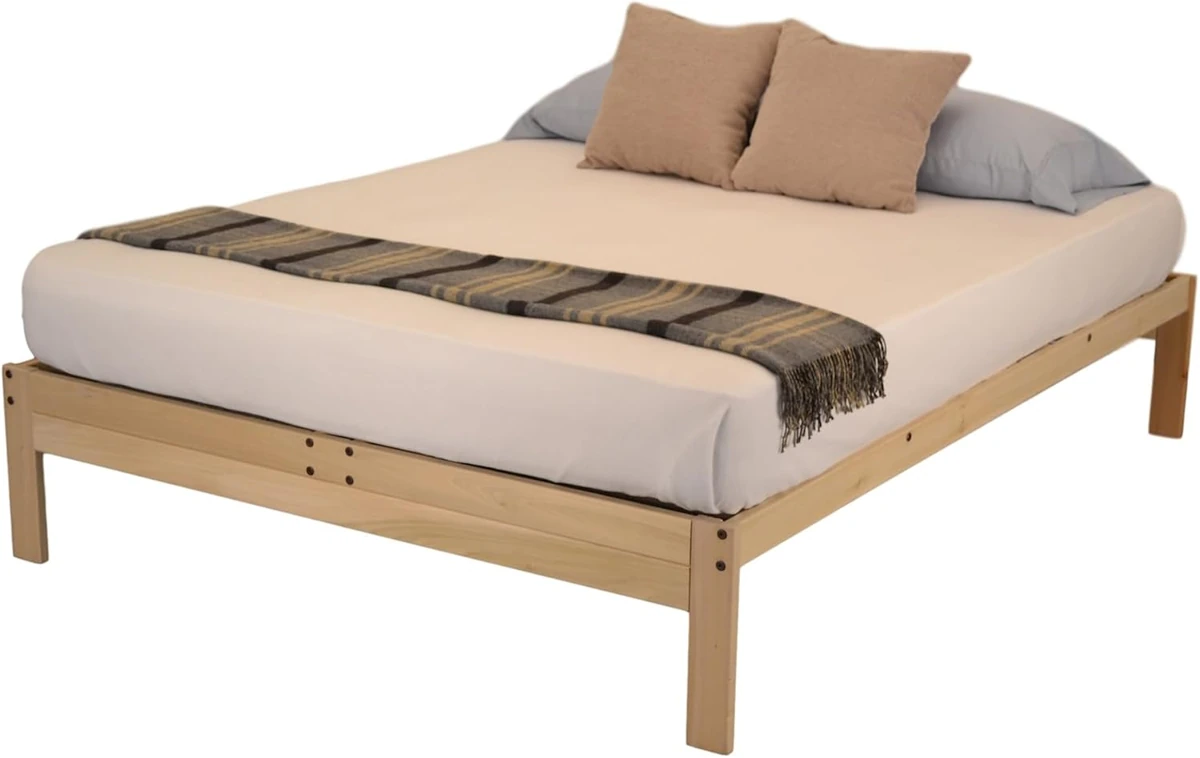
Our wood-frame pick is the current Nomad Queen, with 2.8-inch slat gaps, a 15-inch platform and open floor space beneath its center rails.
Key Details
- Selected configuration
- Queen · unfinished solid Tulip Poplar · model 2871-NP-Q
- Support surface and gap
- Solid-wood slats · 2.8″ gaps; confirm slat width if your mattress specifies a minimum.
- Center support
- Two internal center rails; 4 floor legs and no center floor legs.
- Platform height
- 15″ · 11.75″ clearance under the side rails
- Listed load limit
- 600 lb; the listing does not define mattress inclusion.
- Box spring and extras
- No box spring needed for a mattress that accepts this slat and leg layout. Mattress and storage accessories are separate.
Why We Picked It
We like the Nomad for readers who want visible, unfinished wood and room for bins beneath the side rails. It uses kiln-dried Tulip Poplar rather than a wood-look finish. The current Queen listing gives both a 2.8-inch slat gap and an overall footprint of 81.5 by 60 inches, making it easier to plan than a frame described only as “Queen.”
Its open center is a deliberate tradeoff. Two internal rails support the slats without center legs reaching the floor. That leaves a clearer storage path, but it does not satisfy a mattress rule that specifically calls for additional floor-contact legs. For example, we would exclude this Queen configuration for the PlushBeds bedroom-mattress condition discussed below. Also measure the storage opening you will actually use: 11.75 inches describes clearance under the side rails, not every entry point around the bed.
Pros
- Exact current listing states 2.8-inch slat gaps.
- Unfinished solid poplar suits a natural wood finish.
- No center floor legs obstruct the middle of the floor.
Cons
- Four floor legs conflict with some Queen mattress requirements.
- The 15-inch platform produces a taller finished bed.
Who Should Skip This
Skip this configuration if your mattress requires five or six floor-contact legs, a center floor leg or continuous-deck support. If a floor-supported middle beam is essential and the other mattress conditions match, compare the Parker Queen. Do not substitute the older Nomad 2 when ordering; it has a different slat layout.
3. KD Frames Ekko — Twin
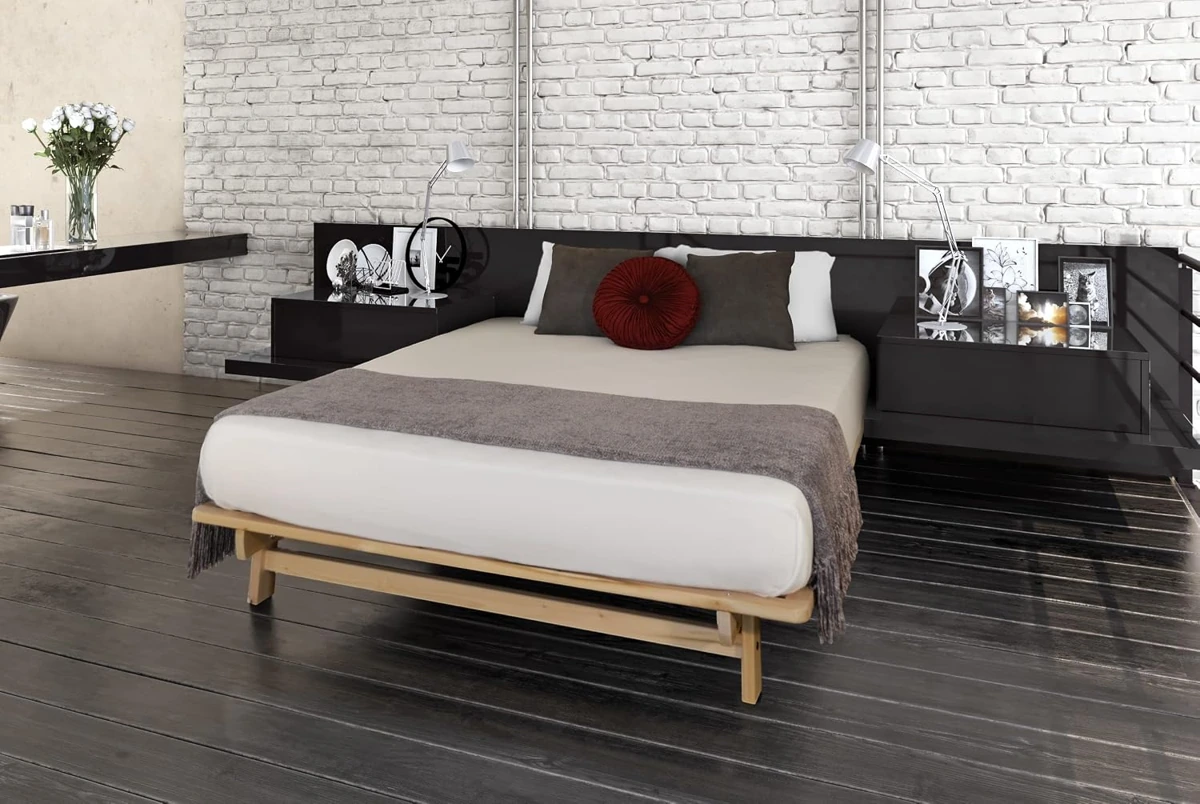
We would pick the Ekko Twin for a low wood platform when the mattress permits 3-inch slat gaps and the inset-leg layout suits the room.
Key Details
- Selected configuration
- Twin · unfinished solid Tulip Poplar
- Support surface and gap
- Two slat decks · 3″ gaps; confirm slat width if required.
- Center support
- Six solid legs; inset end-leg arrangement.
- Platform height
- 10″ · overall footprint 76″ long × 39″ wide
- Listed load limit
- 900 lb; the listing does not define mattress inclusion.
- Box spring and extras
- No box spring needed when this support arrangement is approved for your mattress. Mattress is separate.
Why We Picked It
The Ekko offers a different balance from the Nomad: a platform 5 inches lower, inset legs and a six-leg structure. For a Twin mattress, its 76-by-39-inch footprint also keeps the frame close to the mattress dimensions. We would consider it for a single sleeper who wants an exposed wood frame without the height of a 15-inch platform.
The gap is the deciding number. Three inches is exactly the maximum specified by some latex mattress brands, rather than a margin below it. Check the widest clear opening after assembly and use the requirements for your exact mattress. The inset supports also occupy part of the space under the bed, so a bin that fits under the outside rail may still encounter a leg farther in. Our linked configuration is Twin; its price and dimensions should not be read as a Queen comparison.
Pros
- Low 10-inch platform with inset legs.
- Selected listing publishes the 3-inch slat gap.
- Solid poplar structure with six legs.
Cons
- Not the right pick for a Queen-size purchase.
- Inset supports reduce uninterrupted storage space.
Who Should Skip This
Skip the Ekko Twin if your mattress requires gaps smaller than 3 inches or a solid support surface. Queen shoppers should compare the Nomad Queen or Parker Queen on their own specifications instead of scaling up the Twin figures.
4. LUCID L600 — Queen
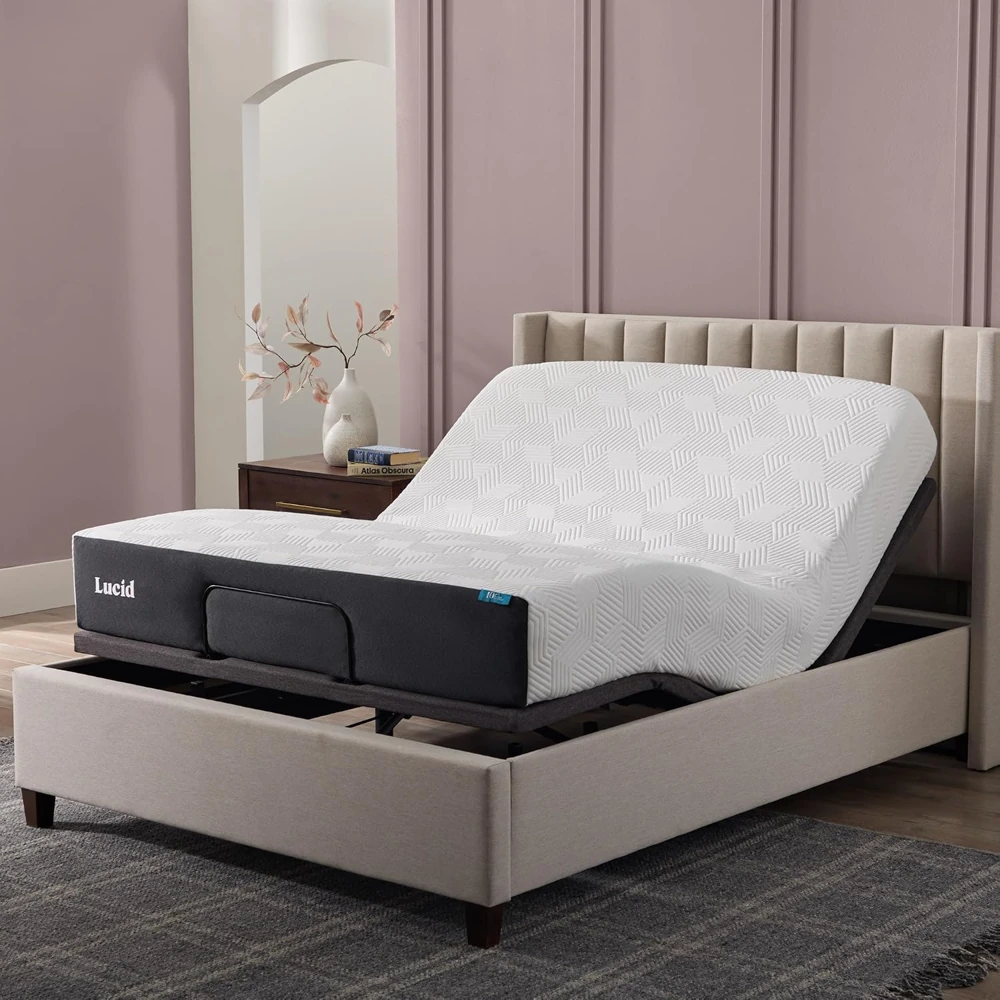
Our adjustable choice is the L600 Queen for a latex mattress explicitly approved to bend on an adjustable base.
Key Details
- Selected configuration
- Queen · L600 · charcoal adjustable base only
- Support surface and gap
- Articulating upholstered panel deck, rather than an ordinary open wood-slat platform.
- Center support
- Integrated steel base and its floor-support system; install according to the L600 manual.
- Platform height
- 15″ listed overall setup height · 79.5″ long × 59.5″ wide
- Listed load limit
- 750 lb for Full/Queen; use the L600 manual’s loading conditions.
- Box spring and extras
- No box spring. Mattress must allow articulation; LUCID recommends 8–14″ mattress thickness. Decorative outer frame is separate.
Why We Picked It
The L600 is the option to consider when changing the head and foot position is part of the purchase. Its upholstered panel deck supports the mattress through the moving sections, while a remote and phone app control the base. It also includes position presets, under-bed lighting and massage functions.
For this guide, mattress fit matters more than the feature list. A latex mattress is not automatically approved for articulation just because latex is flexible: the complete mattress construction and its maker’s instructions determine that. LUCID recommends mattresses 8–14 inches thick, and the selected Queen base is listed at 79.5 by 59.5 inches. If you also want furniture around the powered base, use our bed frames for adjustable bases guide to check the surrounding frame separately.
Pros
- Head and foot adjustment with remote and app controls.
- Panel-deck support provides an alternative to open wood slats.
- Can be considered as a standalone base without a decorative surround.
Cons
- Costs more and adds a powered mechanism.
- Mattress approval and thickness restrict the fit.
Who Should Skip This
Skip the L600 if your mattress maker does not approve the exact mattress for an adjustable base, or if you only want a simple stationary frame. For a broader comparison of powered bases, see our best zero-gravity beds.
What Do Latex Mattress Brands Require?
We use the mattress rules to screen a frame, rather than treating every latex mattress alike. These examples show why the gap measurement is only one part of the decision.
| Mattress or Brand | Published Support Requirement | What It Changes |
|---|---|---|
| Sleep On Latex | Platform or slatted foundation with gaps no wider than 3″. | Compare the actual gap; the brand also permits adjustable frames. |
| SleepEZ Natural / Organic Select Sleep | Slats no more than 3″ apart, or an adjustable base. | An actual spring foundation is not the same as a rigid platform. |
| PlushBeds bedroom mattresses | Solid, rigid support, or slats at least 2.5″ wide with gaps no more than 3″. Queen, King and California King support calls for at least 5–6 legs. | A frame can pass the gap check and still fail the width or floor-leg condition. |
| Zenhaven | Solid platform support, or a suitable plywood, masonite or bunkie-board surface over slats. | Closely spaced open slats alone do not establish the required solid surface. |
All-latex and latex-hybrid mattresses can have different instructions, even when both use “latex” in the name. Follow the support rule for the mattress model and size you own.
How We Choose a Bed Frame for a Latex Mattress
Measure the clear gap, then the slat width
Slat spacing is the empty distance between two neighboring slats. Slat width is the amount of material beneath the mattress. A 2.8-inch-wide slat can still leave a gap that is too large; the two numbers are not interchangeable.
Check several openings, including those near the head and foot, and compare the widest one with the mattress limit. If the mattress also specifies a minimum width, get that second measurement before choosing. Our Parker, Nomad and Ekko comparisons do not treat an unlisted width as automatically compliant.

Look for the load path through the middle
A center rail runs beneath the slats. A center floor leg carries part of that structure down to the floor. A frame may have one without the other: the Nomad uses internal center rails without center floor legs, while the Parker manual shows three center legs.
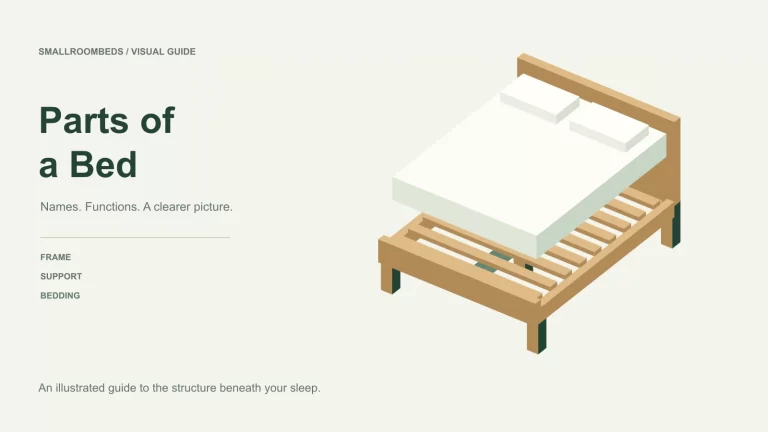
We would not rank these layouts by leg count alone. The important question is whether the complete arrangement matches the mattress instructions. Where the mattress maker requires a center floor leg or a minimum number of floor-contact supports, count the parts that actually reach the floor. Our guide to the parts of a bed explains the rails, slats and other structural pieces.

Read the weight rating before doing the math
Capacity figures can describe different loads. Before subtracting mattress weight from a stated limit, confirm whether the manufacturer includes the mattress in that number. Also check any restriction on concentrated or moving loads, particularly for an adjustable base.
A large rating does not establish suitable slat spacing, and it does not replace the mattress maker’s support layout. We use capacity after those structural checks, rather than as a shortcut around them.
Calculate the finished bed height
The platform height is not the height where you sit. Add the mattress thickness to the height of the supporting surface, allowing for any recess in the frame.
Approximate finished bed height = support-surface height + mattress thickness
With a 12-inch mattress, a 10-inch platform produces roughly a 22-inch bed, while a 15-inch platform produces roughly a 27-inch bed. That 5-inch difference can matter more in daily use than the headboard style. Sit at a comparable height before choosing, and measure storage openings separately from overall frame height.
If bins are a priority, compare our bed frames for storage underneath. A tall rail opening does not guarantee a clear route past center or inset legs.
Use a solid layer only when it solves the right problem
A suitable bunkie board or rigid panel can provide the continuous support required by some mattresses. It does not repair loose joints, an unsupported middle or a frame with inadequate capacity. The added layer also changes bed height and can change airflow beneath the mattress.
Choose the layer as part of a manufacturer-approved support arrangement, with the required thickness, support underneath and ventilation approach. “Bunkie board” is a product category, not proof that every thin fabric-covered board will bridge any gap.
Frequently Asked Questions
Can a latex mattress go directly on slats?
Yes, when the mattress maker permits slatted support and the frame meets its rules for gaps, slat width and floor support. Sleep On Latex and the cited SleepEZ mattress lines allow gaps up to 3 inches. A solid-surface requirement, such as Zenhaven’s, calls for a different setup.
Does a latex mattress need a box spring?
Usually, a suitable platform or foundation provides the support without an additional box spring. An older foundation with actual springs is different from a rigid support base; check the mattress instructions before reusing it. Adding a box spring also raises the finished bed.
Is metal or wood better for a latex mattress?
Either frame material can work. Compare the surface supporting the mattress, its clear gaps, center structure and permitted load. A metal frame with plywood slats and an all-wood platform can have similar spacing but very different floor-support layouts.
Can I use a latex mattress on an adjustable bed?
Use an adjustable base only when the complete mattress model is approved for it. Check thickness and base specifications as well. For the L600, LUCID recommends an 8–14-inch mattress; flexibility of the latex layer alone does not establish compatibility.
Are Full and Queen versions of the same frame equally suitable?
Not necessarily. ZINUS’s Shalini size FAQ, for example, lists a 2.8-inch gap for Full and 3.2 inches for Queen and King. Check the exact size and version instead of transferring a measurement from one variation to another.
Can plywood fix a frame with wide slat gaps?
A suitable rigid layer may address the support surface when both manufacturers permit that arrangement. It does not fix missing structural support or insufficient capacity. Confirm the panel specification and ventilation requirements before making it part of the bed.
Our Final Picks
We would start with the Parker Queen for a lower-cost platform with a floor-supported center beam. The Nomad Queen suits an unfinished-wood room and an open storage path, provided the mattress accepts its four-leg layout. The Ekko Twin is the low wood option for a single mattress, while the L600 Queen serves a different need: adjustable positioning with an approved mattress.
Choose the support arrangement that matches your mattress first. Then use height, finish and storage access to decide between the remaining frames.