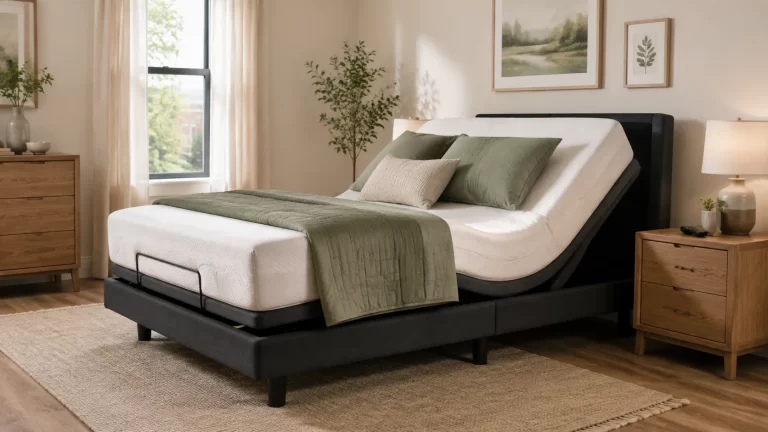
Parts of a Bed: Names, Functions & Labeled Diagrams
BED BASICS · AN ILLUSTRATED GUIDE
A bed is easier to assemble, move, or improve when you know what each piece does. The names can be confusing: a side rail is different from a slat, and a foundation is different from the frame around it. In our guide to the parts of a bed, we connect those names to clear diagrams so you can recognize your own setup.
What are the main parts of a bed? A typical bed includes a frame, mattress support, a mattress, and bedding. Common frame parts are the headboard, footboard or end rail, side rails, slats, legs, and, on many designs, a center support. The exact components depend on the bed’s construction.
Parts of a Bed at a Glance
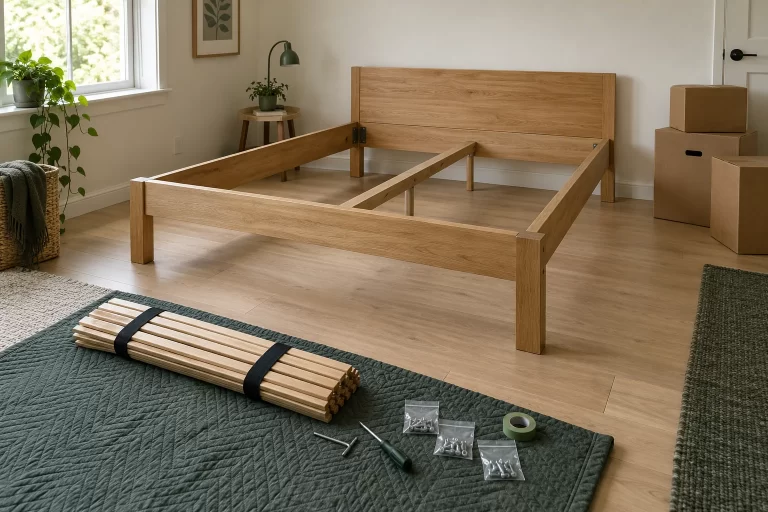
Start with the structure beneath the mattress. Our labeled bed frame diagram shows a wooden frame with slats and a center beam. We have removed the mattress in the top view so the supporting pieces are visible. Other frames may use a metal grid, a solid deck, or a separate foundation.
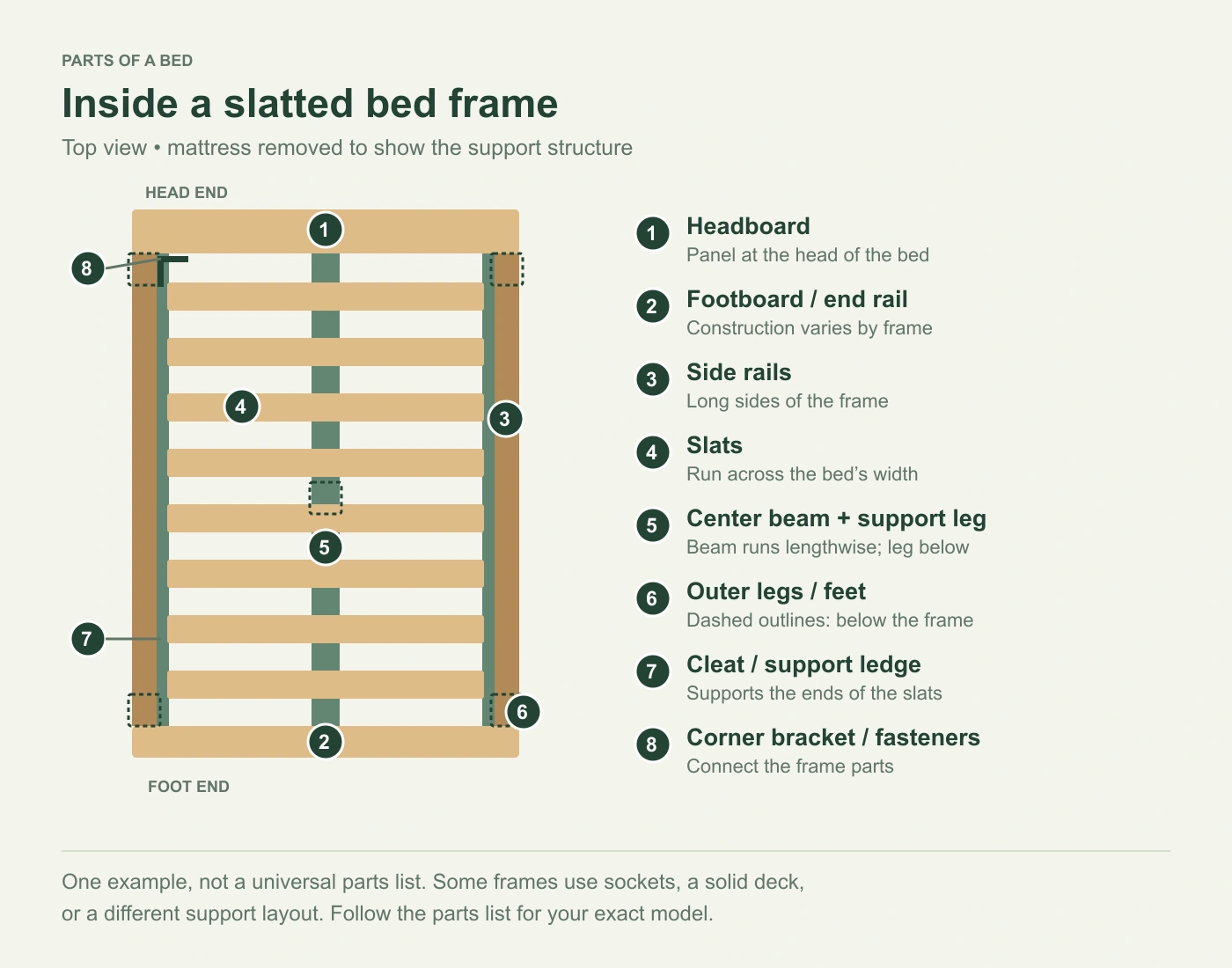
| Part | Where to find it | What it does |
|---|---|---|
| 1. Headboard | At the head end, behind the pillows | Finishes the head of the bed; may also form part of the frame |
| 2. Footboard / end rail | At the opposite end | Closes the frame at the foot; a footboard extends upward |
| 3. Side rails | Along the two long sides | Connect the ends and carry the support system |
| 4. Slats | Across the width, beneath the mattress or base | Support the mattress or a separate foundation, depending on design |
| 5. Center beam and support leg | Along the middle and underneath it | Support the central span and transfer load toward the floor |
| 6. Outer legs / feet | Below the corners or outer frame | Support and elevate the frame |
| 7. Cleats / support ledges | Inside the side rails | Provide a resting surface for slat ends |
| 8. Brackets and fasteners | At joints and attachment points | Connect and secure the components |
These are common components, not a checklist every bed must follow. A frame may integrate several parts into one piece.
Bed Frame Parts Names and What They Do
The bed frame is the structural assembly around or beneath the mattress support. “Bedstead” is another term you may see. Some frames include the entire support surface; others need a separate base before the mattress can go on top.
Headboard and footboard
The headboard stands at the head end of the bed. It may be a wooden panel, upholstered surface, or open metal structure. On a traditional bed, the side rails often attach directly to the headboard’s posts. A wall-mounted headboard, by contrast, can be separate from the load-bearing frame.
The footboard is the raised panel or structure at the foot end. Beds without one may still have a low end rail connecting the sides. A freestanding platform frame can work without a decorative headboard or footboard; an integrated panel bed depends on its designed connections. We check the assembly drawing before treating either end as removable.
Side rails
Side rails run lengthwise along the left and right sides. They connect the head and foot ends and may carry cleats, brackets, or ledges for the mattress support. Wooden side rails often look like long boards; metal ones may be tubes or angle sections.
These are different from guardrails, which rise beside the sleeping surface. Searching for “bed rails” alone can return both structural replacement parts and guardrails, so include the frame brand and the phrase “side rail” when identifying a structural piece.
Slats
Bed slats are repeated strips running across the bed. They can be wood or metal, flat or curved. Some arrive linked by fabric straps; others slot into individual holders. IKEA’s slatted bed bases illustrate how a slat system can be a separate component within a frame.
Closely spaced slats may support a mattress directly. A frame with only a few crosspieces may instead be designed to hold a foundation or box spring. We check the mattress and frame instructions together: the required slat spacing, width, and support arrangement are not identical across all models.
Center support beam and support legs
A center support beam, also called a center rail or midbeam, usually runs from head to foot beneath the slats. It shortens the span the slats must bridge. Some designs add one or more legs beneath that beam, while others support it through a different frame structure.
The beam and the leg are separate things. The beam runs horizontally; the leg carries support downward. When a parts list says “center support,” look at its diagram to see whether it means the beam, a leg, or the complete assembly. The number and position of supports vary by frame and size.
Outer legs, feet, and casters
Legs raise the frame and support it from below. A foot or glide is the piece that contacts the floor; some frames have threaded feet for leveling. A caster is a wheel, commonly seen on rolling frames and rollaway beds.
These pieces affect both overall height and usable space underneath. A listed frame height is not necessarily the storage clearance: a deep side rail can leave a much smaller opening below it.
Cleats, slat holders, and connecting hardware
A cleat is a narrow support strip fixed inside a side rail. Slats rest on it. A slat holder is a socket or cap that locates the end of an individual slat. They serve related purposes but are different replacement items.
Brackets, bolts, screws, washers, hooks, and other connectors hold the assembly together. Some wooden beds use joinery instead of exposed metal hardware. If a joint moves or makes noise, identifying its connection type is more useful than assuming every bed needs the same bolt kit. For a broader comparison of construction choices, see our guide to quieter bed frames.
Bed Frame Hardware: Match the Connection First
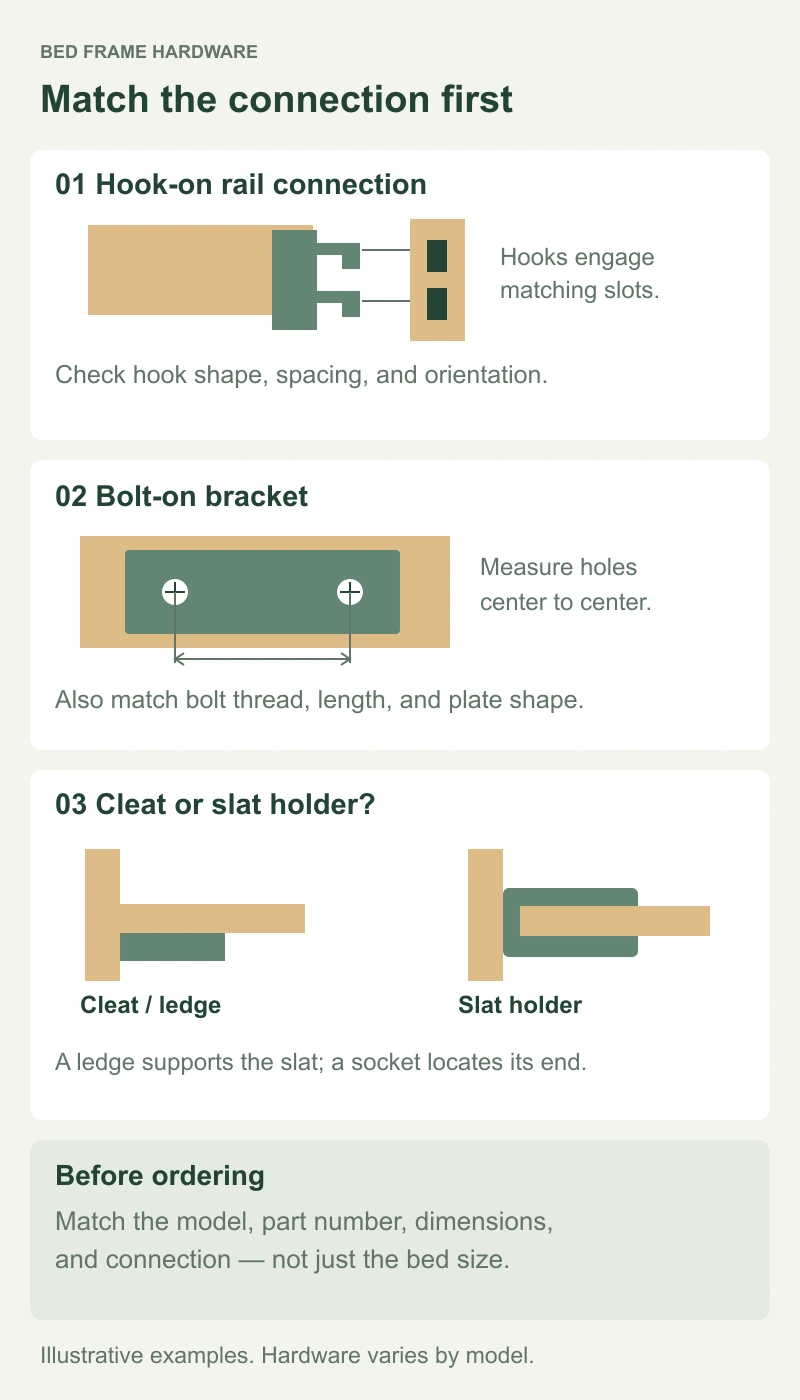
Bed frame hardware includes the fittings that join the larger pieces: rail brackets, hooks, bolts, nuts, washers, and slat sockets. We identify the connection before searching for a replacement kit, because the same part name can describe several incompatible designs.
Hook-on rails versus bolt-on brackets
A hook-on connection has shaped hooks at the rail end that engage matching slots or pins in the bedpost fitting. Check the hook profile, spacing, and direction. A hook plate that looks similar can still sit at the wrong height or fail to engage the matching fitting.
A bolt-on connection uses bolts through a bracket or into threaded fittings. Match the plate shape and measure mounting holes from center to center. The bolt diameter, thread pitch, and length also need to match; the size of the head alone does not identify the fastener.
Slat holders, cleats, and threaded feet
A cleat supports a slat from below, while a holder locates its end in a socket. For a replacement holder, check both the slat opening and the pegs, holes, or clips that attach it to the rail. For a threaded foot, match the thread and usable height range to the original leg. We keep these small fittings with their corresponding rail or leg when taking a bed apart.
What Goes Between the Frame and Mattress?
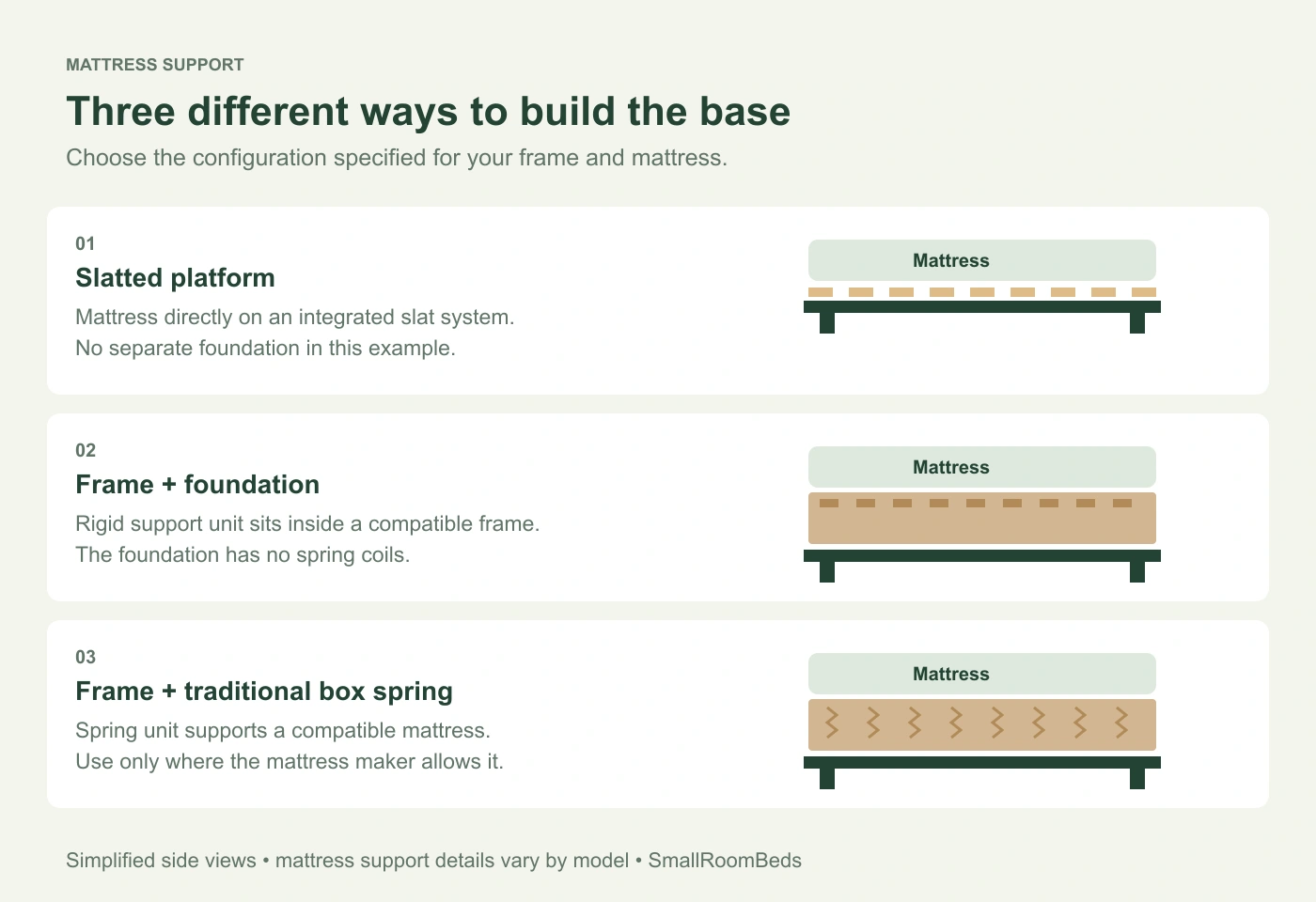
The term bed base broadly describes what supports the mattress. That support can be integrated into the frame or supplied as a separate unit. The three arrangements below are alternatives, not layers you need to stack together.
Platform or slatted base
A platform bed has a support surface built into its structure. That surface might be slats, a metal grid, or a solid deck. When the platform meets the mattress maker’s requirements, the mattress rests directly on it.
This arrangement can keep a setup relatively simple: frame, integrated support, and mattress. A folding platform can use the same principle, with hinges added for storage; our portable bed frame guide compares several examples.
Foundation and box spring
A foundation is a rigid support unit, often covered in fabric, that can sit in a compatible frame. A traditional box spring contains springs inside its frame. They may look similar when covered, but their internal construction and suitability for a mattress differ.
Retail listings sometimes use “box spring” for a rigid, springless base. Read the construction details instead of relying on the product name alone. Casper’s comparison of box springs and foundations explains the distinction and its own mattress requirements.
Bunkie board
A bunkie board is a low-profile mattress support panel or assembly. It can provide a support surface without the height of a full foundation. The name does not specify one universal material, thickness, or load capacity.
It still needs the supporting structure specified for it. We would not treat a thin board as an automatic substitute for a missing center beam or broken frame component.
Mattress and Bedding Layers
“Parts of a bed” can also mean the soft layers above the frame. It helps to separate those layers from the furniture underneath:
- Mattress: the main sleeping surface. Its internal support core and comfort layers vary by construction.
- Topper: an optional layer above the mattress that changes surface feel. It is separate from the mattress itself.
- Protector: a removable protective layer. Fit and placement depend on whether it covers the mattress alone or the mattress and topper together.
- Fitted sheet: the elastic-edged sheet that fits around the sleeping surface. Pocket depth matters when a topper increases thickness.
- Flat sheet: an optional loose sheet between the sleeper and the upper bedding.
- Comforter or duvet: the main warmth layer. A duvet insert typically goes inside a removable duvet cover.
- Pillows and pillowcases: pillows support the head; pillowcases are their removable covers. Shams are usually decorative covers.
- Bed skirt: a fabric layer that conceals the base or the space beneath it.
You do not need every optional layer. When describing a missing piece, tell the seller whether it belongs to the frame, the mattress support, or the bedding. That distinction narrows the search immediately.
How to Identify a Bed Part You Need to Replace
We start with location and shape, then use the model’s parts list to confirm the name. A photo helps, but two pieces that look alike may use different connections.
| What you see | Likely name | What to confirm |
|---|---|---|
| One of several strips across the bed | Slat | Length, width, thickness, curve, and end fittings |
| A long piece down the middle | Center beam / midbeam | Length range, mounting ends, and required legs |
| A narrow ledge inside a side board | Cleat / support ledge | Profile, mounting position, and fixing method |
| A small cap around a slat end | Slat holder / socket | Slat dimensions and how the holder attaches |
| A fitting where two frame sections meet | Corner bracket / rail connector | Hook or bolt pattern, orientation, and part number |
| A vertical piece beneath the middle | Center support leg | Height range and attachment type |
- Find the exact frame. Look for a label, order confirmation, or assembly manual. Include the size and model version, not just the brand.
- Match the diagram and part number. The same brand can use different rails, connectors, and slat holders across its beds.
- Record the measurements. Measure the part and its connection points. For hardware, confirm the thread and length from the manual or supplier rather than matching only the bolt head.
- Contact the original supplier first. For example, IKEA offers a small spare-parts ordering service and directs shoppers to stores for larger pieces. Availability depends on the item.
- Check compatibility before choosing an alternative. “Queen” describes a size category, not a universal connector system. Confirm the actual dimensions and attachments.
Measurements to record before ordering
- Slats: measure one complete slat’s length, width, and thickness. Record whether it is flat or curved and whether end caps are included.
- Rails and center beams: measure the actual piece and note the shape of both mounting ends. For an adjustable beam, record the required working length and its support-leg positions.
- Support legs: record the height from the floor to the mounting surface, the adjustment range, and the attachment type.
- Bolts and brackets: record bolt diameter, thread pitch, specified length, and head type; measure bracket holes center to center and note left/right orientation.
Write the units next to every measurement. A queen-size label does not establish slat length, rail fittings, or hardware compatibility.
Where to find bed frame replacement parts
We start with the manufacturer’s assembly manual and parts diagram, then search its official support or spare-parts page using the exact model and part number.
- IKEA: use the official spare-parts service for small fittings identified by their six-digit part number. Larger items, such as slats or panels, may require a store inquiry.
- Rize Home: its parts and accessories directory is a starting point for matching available components to the specified frame or base.
- Zinus: check Zinus support for assembly instructions and help identifying the correct model and component.
If you contact a supplier, send the model, bed size, part number, measurements, and photos together. This gives them the details needed to check a match.
Take one close-up of the fitting and one wider photo showing where it belongs. Together with the model name and measurements, those images make it much easier for a supplier to identify the correct item.
Which Bed Parts Matter Most in a Small Room?
In a compact bedroom, the frame’s outer edges and the space underneath often matter as much as the mattress size. We look at these details before comparing styles:
- Headboard and footboard projection. A thick or curved end can extend beyond the mattress. Compare full assembled dimensions, especially near a doorway or walkway.
- Side-rail depth and underbed clearance. Measure from the floor to the lowest obstruction, not simply to the top of the frame.
- Support-leg position. Center legs can divide the space beneath the bed, so one long storage bin may not fit even when its height does.
- Drawers and moving parts. Include the space needed to pull drawers out or unfold a frame.
For total sleeping height, measure from the floor to the surface directly beneath the mattress, then add the mattress and any topper. If a foundation is already included in that floor-to-surface measurement, do not count its height again. Our bed height calculator helps you work through the measurements.
Frequently Asked Questions
What are the wooden pieces under a mattress called?
The repeated wooden strips are usually bed slats. A single broad panel may be a platform deck or bunkie board. A long piece down the center is usually a center beam. Location and shape distinguish them more reliably than material alone.
What is the bottom of a bed called?
If you mean the end near your feet, it is the foot end, often finished with a footboard or end rail. If you mean the structure beneath the mattress, you may mean the base, foundation, or frame.
Is a bed frame the same as a foundation?
No. A frame is the supporting furniture structure; a foundation is a mattress-support unit that may sit within it. A platform frame combines these roles by including its own support surface.
Does every bed need a box spring?
No. Many beds support the mattress on an integrated platform or slat system. Other frames require a separate support unit. Use the combination specified by both the frame and mattress manufacturers.
Are bed frame replacement parts universal?
Usually, compatibility needs to be checked. Frames of the same nominal size can differ in rail length, slat dimensions, bracket style, and hole spacing. The original model number and parts diagram are the best starting points.
Once you separate the frame, mattress support, and bedding, the names become much easier to use. Start with the diagram, locate the part on your own bed, and match its details to the model’s parts list. That gives you a clearer starting point for assembly, replacement, or choosing your next frame.