Best King Size Metal Bed Frames: Compare Fit, Support, and Storage
Bed buying guides · U.S. standard King
The best king size metal bed frame combines a suitable mattress-support surface, a well-supported center, secure connections, and a footprint your bedroom can accommodate. Start with those essentials, then choose the height and headboard style. This guide explains how the structure works and matches five frames to distinct bedroom needs.
Updated September 6, 2026 · U.S. standard King buying guide
Affiliate disclosure: As an Amazon Associate I earn from qualifying purchases. If you buy through our Amazon links, we may earn a commission.
Which King metal bed frame should you choose?
Start with your non-negotiable. For a folding platform with generous listed clearance, look at Amazon Basics. For a low bed with a metal frame, consider Zinus Joseph. If you specifically want steel slats, compare Olee Sleep. Zinus SmartBase Super Heavy Duty deserves a closer look when the advertised load rating matters, while ALLEWIE adds a headboard and footboard.
We compare these frames using structural design, mattress-support requirements, King dimensions, and room-clearance calculations. Our recommendations are editorial assessments based on documented specifications and technical guidance.
| Product | Best For | Deciding Detail | Main Tradeoff | Skip If |
|---|---|---|---|---|
| Amazon Basics 18-inch Foldable Metal Platform | Best for Tall Folding Storage | 17-inch clearance and folding construction | Tall finished bed with a thick mattress | Your mattress makes the 18-inch platform too high for easy access |
| Zinus SmartBase Super Heavy Duty 14-inch | Best for a Higher Stated Load Rating | Product-specific higher advertised load rating | Load capacity does not establish stiffness or service life | You are choosing only by the capacity number without confirming mattress support |
| Zinus Joseph 10-inch Platform | Best Low Platform | Ten-inch platform for a lower finished bed | Less potential storage height; plywood support | Your mattress maker excludes plywood support or your bins need a tall opening |
| Olee Sleep 14-inch Heavy Duty Steel Slat Frame | Best Simple Steel-Slat Platform | Conventional steel slats and an open bed end | Wider and longer than the King mattress | Your layout cannot spare the 77.5 × 81.5-inch exterior |
| ALLEWIE Victorian Iron-Art King Frame | Best with Decorative End Boards | Complete metal headboard and footboard | Footboard occupies the end route | You need an open foot end or the 82.9-inch length crowds the passage |
On a phone, swipe the table to compare the deciding detail, tradeoff and skip condition.
The comparison uses the listed King configurations and the structural and room-planning criteria explained in this guide. *A nominal 76 × 80-inch King mattress extends beyond Joseph’s listed platform, so use at least the mattress dimensions for room planning. †ALLEWIE lists 12.4 inches as ground clearance/bed-foot height; verify the actual opening. Its 47.6-inch overall height includes the headboard and is not the sleeping platform height.
Select the stated King size and platform height when comparing offers. The total purchase includes delivery, any separate headboard or brackets, and the applicable return terms; variants grouped on one page can have different support designs.
In this guide
What makes a good King metal bed frame?
A King frame has two jobs: provide an appropriate surface beneath the mattress and transfer its load to the floor without unwanted movement. A strong perimeter cannot compensate for an unsuitable support surface. Closely spaced slats cannot fix poorly connected rails. Judge the complete assembly.
Follow the support from mattress to floor
Weight passes from the mattress into the slats or grid, through the supporting rails and beams, and down the legs. This is the load path. On a broad King platform, the middle of that system deserves as much attention as the corners.
A properly supported center beam divides a long unsupported span into shorter sections. As a general structural principle, shortening the span reduces bending for an otherwise comparable member and loading arrangement. The useful question is where each slat is supported, rather than how many slats appear in a photograph.
The center beam also needs a connection to the floor through its intended supports. A leg suspended above the floor cannot provide its intended support until enough movement occurs to engage it. Install and adjust the supports according to the frame instructions, particularly on uneven floors. More legs help only when their placement and contact contribute to the structure.
Separate capacity from stiffness
Capacity describes a stated loading limit. Stiffness describes how much the structure moves under load. A frame may carry the occupants while still feeling flexible when someone sits on an edge or turns over. An unusually large capacity number does not settle that distinction.
Metal members depend on material, cross-section, wall thickness, span, and connections. A photograph of a large tube does not establish its wall thickness. Without comparable construction details and testing, advertised capacities cannot establish which frame resists movement better.
For a shared King bed, first screen for an adequate model-specific load limit. Then prioritize the center-support arrangement, secure connections, mattress compatibility, and room fit. A high rating is useful when it addresses a real requirement; it is not a complete definition of quality.
Match the mattress-contact surface
A metal perimeter can support wood slats, steel slats, or a steel grid. The frame material does not determine compatibility. Gaps, supporting width, and the mattress manufacturer’s requirements matter at the contact surface.
Large gaps leave larger areas of the mattress without direct support. Narrow bars and broad slats provide different contact surfaces even where the clear gaps are similar. Measure the empty space between adjacent supports, rather than center-to-center spacing.
Tempur-Pedic’s support guidance specifies slats at least three inches wide and less than four inches apart for the described platform arrangement. Purple’s warranty uses a maximum 3.5-inch gap for its covered slatted configurations. Tempur-Pedic’s same page also excludes plywood or untreated-wood support surfaces from its approved platform guidance. These are brand-specific requirements, not interchangeable rules for every mattress.
A metal frame with suitable wood slats can therefore be a better match than an all-steel frame with inappropriate support geometry. Resolve this compatibility before choosing storage height or headboard styling.
Assess joints and movement separately from noise claims
Vertical support and side-to-side movement are different aspects of the assembly. Rail connections, corner joints, bracing, and floor contact affect its behavior. A tall decorative headboard introduces another connection; it should not automatically be treated as reinforcement for the platform.
Noise can occur when components move against one another. Saatva’s troubleshooting guidance identifies loose fasteners and rubbing parts among common causes, while distinguishing sounds from the mattress and foundation. Metal alone does not establish whether a bed will be quiet.
Accessible connections make the manufacturer’s specified maintenance easier. Secure slat seating and supplied contact pads are relevant details, but they do not prove permanent silence. Correct assembly and replacement of damaged components take priority over improvised padding or lubrication.
Make height earn its space
Platform height changes sleeping height and storage possibilities; it does not make a King narrower. With a twelve-inch mattress, a ten-inch platform produces a nominal twenty-two-inch sleeping surface. An eighteen-inch platform produces thirty inches, before any recess or extra foundation is considered.
For storage, plan three things together: container height, the opening between supports, and the pull-out route. A seventeen-inch cavity does little for a container that cannot pass between the legs. A bin that fits beneath the frame can still be inconvenient to retrieve through a narrow bedside aisle.
Our starting recommendation: prioritize a compact, open-ended platform when circulation is limited. Choose a taller folding base when accessible storage and dismantling matter more. Choose a lower platform for a thick mattress or a preferred lower sleeping surface. Each solves a different problem; none removes the footprint of the King mattress.
Our King metal bed frame recommendations
Before You Choose
- Does the room work around a 76 × 80-inch mattress? Use any larger frame exterior and leave operating routes.
- Which mattress-contact surface is allowed? Steel grids, steel slats and plywood slats are different supports.
- What does the extra height buy? Balance container access with finished sleeping height and the need for end boards.
1. Amazon Basics 18-inch Foldable Metal Platform
King · Amazon Basics 18-inch Foldable Metal Platform
We recommend Amazon Basics 18-inch Foldable Metal Platform for its 17-inch clearance and folding construction.

Key Details
- Selected configuration
- King · Amazon Basics 18-inch Foldable Metal Platform
- Listed frame footprint (L × W)
- 80 × 76 in
- Frame and mattress support
- Folding steel platform; compatible mattress directly on support
- Height and storage access
- 18 in platform; 17 in listed underbed clearance
- Included features and setup
- No decorative headboard; open storage
Why We Picked It
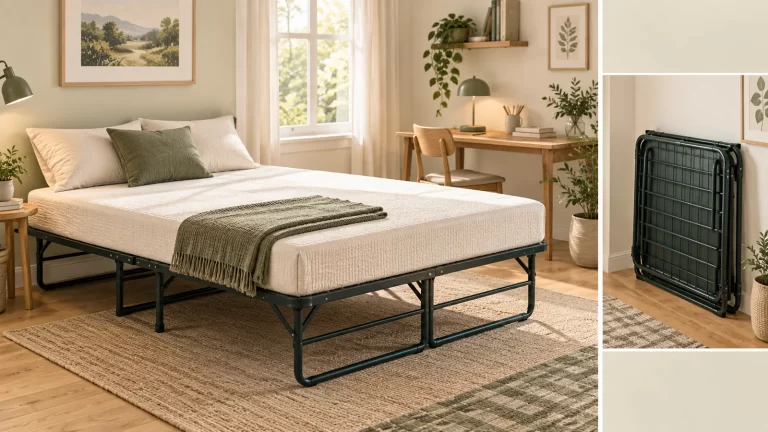
Best suited to accessible under-bed storage and frequent moves. The eighteen-inch platform prioritizes vertical storage room, while the folding format makes this a practical choice for a bedroom that may need to be dismantled. Its compact 76 × 80-inch footprint avoids the additional length of a decorative footboard.
The design works best when storage is part of the room plan from the start. Select containers that pass between the supports and can be pulled out through the available aisle. The listed seventeen-inch clearance is useful height, but it does not describe the width of those openings.
Our verdict: choose this configuration for storage capacity rather than a low bed profile. With a twelve-inch mattress, the nominal sleeping surface reaches thirty inches, so it is a less natural match for someone who prefers a lower sitting height. The advertised 700-pound total and 350-pound per-person limits must both suit the intended occupants; the steel support grid must also meet the mattress requirements.
Pros
- Folding structure for moves
- 17-inch listed storage clearance
Cons
- Higher finished bed
- Containers must pass between supports
Who Should Skip This
Skip this bed if your mattress makes the 18-inch platform too high for easy access. Compare the 10-inch Joseph if a lower bed matters more than tall storage.
View Amazon Basics 18-inch Foldable Metal Platform on Amazon
2. Zinus SmartBase Super Heavy Duty 14-inch
King · SmartBase Super Heavy Duty 14-inch
We recommend Zinus SmartBase Super Heavy Duty 14-inch for its product-specific higher advertised load rating.

Key Details
- Selected configuration
- King · SmartBase Super Heavy Duty 14-inch
- Listed frame footprint (L × W)
- 80 × 76 in
- Frame and mattress support
- Folding steel support grid; maker advertises 4,400 lb capacity for this version
- Height and storage access
- 14 in platform; 12.8 in listed clearance
- Included features and setup
- No decorative headboard; clarify the rating’s weight basis
Why We Picked It
Best suited to buyers whose first screening criterion is load capacity. SmartBase Super Heavy Duty combines a folding steel grid with a fourteen-inch platform. That places it between the low Joseph and the taller Amazon Basics in sleeping-height terms, while its listed 12.8-inch clearance allows space for appropriately sized containers.
The manufacturer advertises a 4,400-pound capacity for this King version. That makes it a relevant shortlist option for a higher stated load requirement, but it does not demonstrate superior resistance to lateral movement or establish a service life. Capacity, stiffness, and fatigue performance are separate properties.
Our verdict: consider this exact Super Heavy Duty configuration when its capacity specification addresses a real requirement. Do not pay for the number alone: the grid must still suit the mattress, and the folding sections must be assembled and supported correctly. The rating’s weight basis should be clarified where it affects the purchase.
Pros
- Specific King load specification
- Folding steel grid with storage clearance
Cons
- Grid must meet mattress rules
- Capacity is not a stiffness measurement
Who Should Skip This
Skip this base if you are choosing only by the capacity number without confirming mattress support. Compare the support-system checks before deciding whether this rating addresses your setup.
3. Zinus Joseph 10-inch Platform
King · Joseph 10-inch
We recommend Zinus Joseph 10-inch Platform for its ten-inch platform for a lower finished bed.

Key Details
- Selected configuration
- King · Joseph 10-inch
- Listed frame footprint (L × W)
- 79.5 × 75.5 in
- Frame and mattress support
- Steel frame with plywood mattress-support slats
- Height and storage access
- 10 in platform; underbed opening requires confirmation
- Included features and setup
- No included decorative headboard
Why We Picked It
Best suited to a thick mattress and a lower sleeping surface. Joseph’s ten-inch platform is the most direct low-height choice in this comparison. It combines a steel perimeter with wood slats, making it relevant to buyers who want a simple metal frame without an all-metal mattress-contact surface.
Its low silhouette leaves more wall visible and avoids the visual bulk of a tall headboard. The room benefit is primarily visual: a nominal King mattress still occupies 76 × 80 inches even though the platform is listed at 75.5 × 79.5 inches. Use the mattress envelope when calculating clearance.
Our verdict: choose Joseph when finished bed height matters more than tall storage. With a twelve-inch mattress, the nominal top surface is twenty-two inches. The compromise is reduced potential storage height, and the ten-inch platform measurement is not a verified opening. Its plywood slats also need to meet the mattress maker’s material and spacing rules. In particular, do not assume suitability for a Tempur-Pedic mattress: the brand’s platform guidance discussed above excludes plywood support surfaces.
Pros
- Lower platform than the other stated heights
- Simple steel perimeter
Cons
- Reduced storage height
- Plywood must satisfy mattress requirements
Who Should Skip This
Skip this bed if your mattress maker excludes plywood support or your bins need a tall opening. Compare Olee Sleep for steel slats, subject to the required gap and center support.
4. Olee Sleep 14-inch Heavy Duty Steel Slat Frame
King · Olee Sleep 14BF04K · 14-inch
We recommend Olee Sleep 14-inch Heavy Duty Steel Slat Frame for its conventional steel slats and an open bed end.

Key Details
- Selected configuration
- King · Olee Sleep 14BF04K · 14-inch
- Listed frame footprint (L × W)
- 81.5 × 77.5 in
- Frame and mattress support
- Assembled steel-slat platform
- Height and storage access
- 14 in platform; about 13 in listed clearance
- Included features and setup
- Headboard attachment option; headboard not included
Why We Picked It
Best suited to a straightforward steel-slat platform. Olee Sleep’s 14BF04K provides a conventional assembled frame with steel slats and an open bed end. Its fourteen-inch platform offers a middle height among these choices, with approximately thirteen inches of listed storage clearance.
The important small-room detail is the 77.5 × 81.5-inch outside footprint. Compared with a 76 × 80-inch mattress envelope, it consumes another 1.5 inches of room width and length. Centered in the same room, that reduces each side gap by 0.75 inch and the foot gap by 1.5 inches. These modest differences still belong in the plan.
Our verdict: a useful choice for shoppers who prefer steel slats and an uncluttered platform shape. Select it for that arrangement, not for an assumed noise advantage over wood slats. The advertised headboard compatibility is an attachment option, not an included headboard; adding one may change the complete footprint. Slat openings must match the mattress requirements.
Pros
- Steel-slat support
- Open-ended platform with optional headboard attachment
Cons
- Extra perimeter space
- Headboard is separate
Who Should Skip This
Skip this bed if your layout cannot spare the 77.5 × 81.5-inch exterior. Compare Amazon Basics for a closer footprint if its taller platform works.
View Olee Sleep 14-inch Heavy Duty Steel Slat Frame on Amazon
5. ALLEWIE Victorian Iron-Art King Frame
King · ALLEWIE Victorian Iron-Art
We recommend ALLEWIE Victorian Iron-Art King Frame for its complete metal headboard and footboard.

Key Details
- Selected configuration
- King · ALLEWIE Victorian Iron-Art
- Listed frame footprint (L × W)
- 82.9 × 76.4 in
- Frame and mattress support
- Metal support slats; confirm the capacity for the selected version
- Height and storage access
- 47.6 in headboard; 12.4 in listed clearance; confirm platform height
- Included features and setup
- Decorative headboard and footboard included
Why We Picked It
Best suited to a bedroom where an included headboard and footboard are priorities. ALLEWIE’s Victorian Iron-Art frame creates a finished bed silhouette without a separate headboard purchase. Its 76.4 × 82.9-inch footprint is close to mattress width but extends farther at the ends.
The footboard is the key functional trade-off. It adds a physical boundary when walking around the bed or changing bedding. A room with a tight foot passage usually benefits more from an open-ended platform; a room with sufficient clearance can accommodate the decorative structure more comfortably.
Our verdict: choose this option for its complete metal-bed styling. Its 47.6-inch overall height describes the headboard, not the platform. The listed 12.4-inch clearance also needs to accommodate the container’s actual route. Conflicting 800- and 1,000-pound capacity figures prevent a defensible high-load recommendation, so that issue remains relevant for buyers relying on a particular limit.
Pros
- Included decorative headboard and footboard
- Metal-slat support
Cons
- Footboard constrains access
- Capacity figures need resolution for a load-based choice
Who Should Skip This
Skip this bed if you need an open foot end or the 82.9-inch length crowds the passage. Compare Olee Sleep for an open-ended steel platform.
Will a King metal bed frame fit your room?
A U.S. standard King mattress is nominally 76 inches wide and 80 inches long, as shown in Purple’s King-size comparison. The assembled frame can extend beyond it, while some platforms sit slightly inside the mattress edges. Plan with the larger width and the larger length of the complete bed. Measure projections such as headboard feet, brackets, and curved posts too.
The two plans below use Olee Sleep’s listed 77.5 × 81.5-inch outside footprint. Both rooms are drawn at the same scale, with the bed centered and its head touching the upper wall. Each includes a 30-inch inward-swinging door at the lower-right corner. Furniture, baseboards, bedding overhang, and any required wall offset are excluded.
10 × 10 ft room
12 × 12 ft room
Foot gap = room length − bed envelope length − head-end offset
For the 10 × 10-foot room, the calculation is (120 − 77.5) ÷ 2 = 21.25 inches per side, with 120 − 81.5 = 38.5 inches at the foot. For the 12 × 12-foot room, the corresponding gaps are 33.25 inches and 62.5 inches. These are geometric clearances, not a comfort guarantee or an accessibility standard.
The difference becomes clearer when you add furniture. In the smaller room, an illustrative 18-inch-deep dresser directly opposite the bed reduces the closed-drawer foot passage to 20.5 inches. A drawer extending another 14 inches leaves 6.5 inches in front of it. In the larger room, the same two deductions leave 44.5 inches with drawers closed and 30.5 inches with that drawer open.
Those figures do not check the dresser’s width or the entry door. Tape out the dresser separately and test both openings. A narrow strip of unoccupied floor is not necessarily a route you can use while carrying laundry or changing sheets.
A 10 × 10 room therefore deserves a particularly careful King-versus-Queen comparison. Our 10×10 bedroom guide shows the size trade-offs. If you are still choosing the mattress size, work through the room-first bed buying guide before committing to a King frame.
Six checks before buying a King metal frame
1. Confirm mattress compatibility
Match the exact mattress model’s requirements for support material, slat width, clear spacing, and center support. Obtain any missing dimensions before purchase. An added board or foundation must also be approved for that mattress; it is not a universal fix for an unsuitable platform.
2. Test the finished sleeping height
Add mattress thickness to the actual support-surface height, allowing for any recess. Compare that total with a bed or seat you can try. Both sleepers should be comfortable sitting down, getting up, and reaching the floor; extra storage height is useful only when the bed remains convenient to use.
3. Tape out the storage route
Measure containers with lids, handles, and wheels included. Check the lowest opening and the width between legs or braces, then mark the space needed to pull each container out. Include carpet and hand clearance. Smaller bins may be more accessible than one large container beside a wall or nightstand.
4. Check the load-rating basis
Establish whether the stated limit includes the mattress and foundation as well as occupants. Apply any individual limit in addition to the total. If capacity is decisive, retain written clarification for the exact model with the order details.
5. Inspect the assembled support
Follow the supplied assembly and tightening sequence. Check that slats are seated, required parts are present, and intended floor-contact supports reach the floor. Follow the manufacturer’s maintenance instructions. Persistent movement or noise after correct assembly warrants inspection and seller support.
6. Confirm what the order includes
Check King rather than Queen or California King, platform height, and included hardware. A headboard-compatible frame may still need separate brackets and a headboard. Review the delivered total and return arrangements, including repacking, before checkout.
King metal bed frame FAQ
What is the best King size metal bed frame for a small room?
Choose the smallest verified bed envelope that meets your mattress and support needs, then check the height and storage access. A decorative frame may project beyond the mattress; a slim platform may not. None of those differences changes the space taken by a standard King mattress itself. Use the actual room plan to decide whether King is practical.
Can a King bed fit in a 10×10 bedroom?
It can fit geometrically. Our illustrated frame leaves 21.25 inches on each side and 38.5 inches at the foot before furniture or wall offsets. Whether that works depends on the entry door, closet access, bedside furniture, and the people using the room. Tape out the whole bed and walk the routes before buying.
Do these metal bed frames need a box spring?
The five linked configurations are advertised for use without one. Your mattress’s support instructions still control compatibility. Check the support surface and spacing rather than assuming that the frame’s box-spring statement overrides the mattress maker’s requirements.
Is a 14-inch or an 18-inch frame better?
Choose by finished sleeping height and usable storage access. The taller option may accommodate taller containers, but it also raises the mattress. Compare platform height plus your mattress thickness, then check the actual under-bed clearance and openings. The advertised frame height alone cannot answer either question.
Will a California King mattress fit a standard King frame?
Do not treat the sizes as interchangeable. A nominal California King is 72 × 84 inches; a standard King is 76 × 80 inches. One is narrower and longer. Choose the frame configuration specified for your mattress, even when a listing’s product photos look similar.
What makes a metal bed frame squeak?
Movement at joints, loose fasteners, and rubbing components can create noise; the mattress or foundation may also be the source. Correct assembly and suitable floor contact matter more than the metal label alone. Follow the manufacturer’s inspection and maintenance instructions if noise develops.
Choose the trade-off your room can live with
For folding storage, begin with Amazon Basics. For a lower platform, look at Joseph. Olee Sleep is the steel-slat option to compare, SmartBase Super Heavy Duty is the load-rating candidate to investigate, and ALLEWIE suits shoppers who want the decorative headboard included.
Before buying any of them, settle three measurements: the complete bed footprint, the finished sleeping height, and the narrowest storage opening. Then confirm mattress support and the exact King offer. Those checks do more for a useful bedroom than choosing the largest number in a product title.