Dorm Bed Size: Twin XL Dimensions & Bedding Fit
DORM ROOM PLANNING · SIZE & BEDDING GUIDE
Planning a college bedroom starts with a few measurements that affect almost everything you pack. Your dorm bed size determines which sheets and topper fit, while the frame’s outside dimensions determine how much room you have for a desk, storage, and a clear path to the door. We separate those measurements below so you can build your bedding list around the bed you will actually use.
What size is a dorm bed? Twin XL is a common U.S. college dorm size, usually listed in retail size charts as 38 inches wide by 80 inches long (about 97 × 203 cm). It is 5 inches longer than a standard Twin. However, campuses also use narrower 36-inch mattresses, standard Twins, and other sizes. Confirm your assigned building’s dimensions before choosing fitted bedding.
Dorm Bed Size Chart: Inches and Centimeters
Use this chart to understand the size names you will see while shopping. Dimensions are width × length; they describe the mattress, not the complete bed frame. Centimeter values are rounded.
Swipe sideways to see all columns.
| Size or configuration | Inches | Centimeters | What to check |
|---|---|---|---|
| Twin | 38 × 75 | 97 × 191 | Used in some residence halls; shorter than Twin XL |
| Twin XL | 38 × 80 | 97 × 203 | A common dorm option; shop for the extra length |
| Narrow campus Twin XL | 36 × 80 | 91 × 203 | Published by some schools; compare actual bedding and topper dimensions |
| Full / Double | 54 × 75 | 137 × 191 | A wider option in some housing; do not assume an apartment assignment includes one |
Retail measurements can vary slightly by brand. A school may describe a 39-inch-wide bed as Twin or Twin XL. Its room-specific measurements take priority over a general chart.
We use the Sleep Foundation’s dorm size comparison as a reference for the common retail labels. The 36-inch-wide example comes from university furniture specifications, including the Ohio State example below.
Twin vs. Twin XL: The Extra 5 Inches Matter
In common retail sizing, Twin and Twin XL have the same 38-inch width. A Twin is 75 inches long, while a Twin XL is 80 inches long. That adds about 13 centimeters of length without making the bed wider.
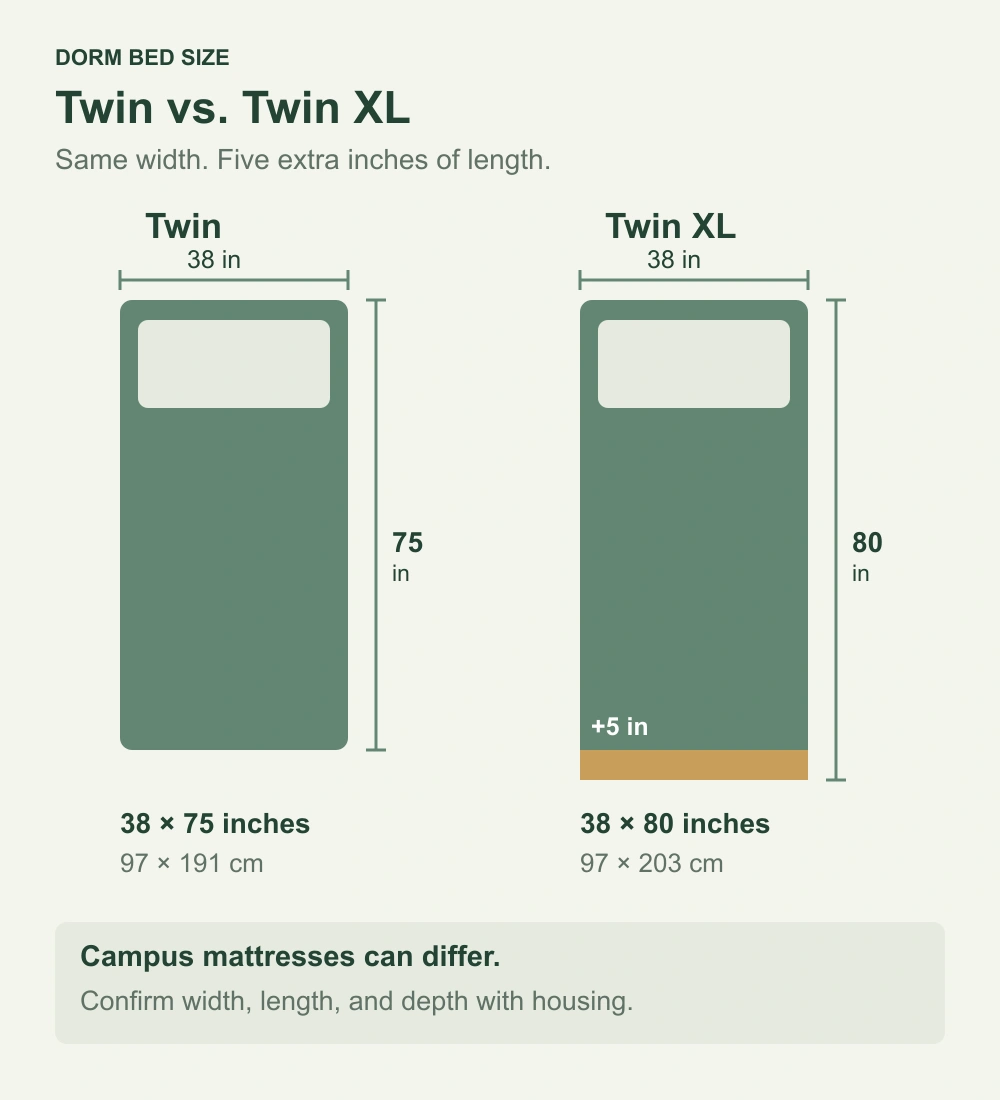
The difference matters most for fitted items. A fitted sheet cut for a 75-inch Twin does not gain the missing length simply because it has deep pockets. A Twin topper on an 80-inch mattress also leaves a short section uncovered. We match the footprint first, then check thickness and fabric fit.
A comforter works differently because it lies over the bed rather than wrapping tightly around its corners. Some brands sell one Twin/Twin XL comforter for both sizes. Its actual width and length, together with the amount of overhang you want, determine whether it suits your setup.
For taller students, an 80-inch mattress provides more length than a 75-inch one, but there is no single height cutoff that makes every person comfortable. Pillow placement, sleeping position, and an enclosed foot end also affect usable space. Ask housing about available arrangements if the assigned length will not work for you.
Not Every Dorm Has the Same Bed: Official College Examples
We checked university housing information because a campus name alone may not identify the mattress. The following examples show why the building—and sometimes the floor—matters.
Swipe sideways to see all columns.
| University and location | Published size | What it shows |
|---|---|---|
| Temple: 1300 Residence Hall, floors 1–3 | Standard Twin: 39 × 75 in | A traditional Twin can be the assigned dorm bed |
| Temple: 1300 Residence Hall, floors 4–5 | Extra-long: 39 × 80 in | Different floors in one building can have different lengths |
| University of Oregon: Earl Hall | Regular Twin: 36 × 75 in | Some campus mattresses are narrower than the common retail size |
| University of Oregon: Justice Bean Hall | Twin XL: 36 × 80 in | “Twin XL” does not always mean exactly 38 inches wide |
| Ohio State: Nosker House | Twin XL mattress: 36 × 80 in | The published frame is larger: 38 × 85 in |
Sources checked October 3, 2026: Temple’s packing and bed dimensions page, Oregon’s 2025 residence hall measurement sheet (PDF), and Ohio State’s Nosker House furniture sheet (PDF). These are examples for the named locations, not campus-wide guarantees.
If a general college checklist says Twin XL but your assigned hall’s current furniture sheet lists something different, resolve that difference with housing before ordering a topper. A stretchy sheet and a slab of foam do not accommodate a width mismatch in the same way.
What Size Sheets, Topper, and Comforter Fit a Dorm Bed?
Once you have the mattress width and length, work through each layer separately. We find this more useful than assuming every item in a “college bedding bundle” will fit the same way.
Fitted sheets: match the footprint and pocket depth
For a confirmed standard Twin XL mattress, start with a Twin XL fitted sheet. Check the manufacturer’s stated mattress dimensions and supported depth. The flat sheet in a set can be much larger than the mattress; those measurements are not the dimensions of its fitted sheet.
Next, add the thickness of the layers that will sit inside the fitted sheet. For example, an 8-inch mattress plus a 3-inch topper makes an approximately 11-inch stack before any additional padded layer. Choose a sheet whose stated fit range accommodates that stack. An “extra-deep” label is less helpful than the actual depth range printed in the listing.
On a 36-inch-wide dorm mattress, a sheet made for a wider Twin XL may fit more loosely. Follow the housing office’s bedding recommendation and compare the sheet’s fit information. The extra length remains important even when the mattress is narrow.
Mattress toppers: match the actual surface
A topper should match the mattress’s usable width and length. Check its numerical dimensions rather than relying only on the Twin XL name. A 38-inch topper on a 36-inch mattress is wider than the sleeping surface; buying the familiar label does not remove that difference.
Topper thickness also changes the height of the finished bed and the fitted sheet you need. On a university bunk or loft, use the permitted mattress-and-topper arrangement specified for that bed. Confirm the maximum permitted thickness before choosing a thick topper.
Protectors and encasements: check what they cover
A fitted protector needs the correct footprint and enough depth for the layers it is designed to cover. A zippered encasement surrounds the mattress, so all three dimensions matter. Decide whether the topper will sit inside or above the protective layer according to the product’s instructions, then measure that intended arrangement.
Comforters and duvets: choose the drop you want
Compare the comforter’s actual dimensions with your mattress rather than looking for one universal “dorm comforter size.” For a centered comforter, the approximate side drop is (comforter width − mattress width) ÷ 2. A 68-inch-wide comforter on a 38-inch-wide mattress has about 15 inches of drop on each side before allowing for bedding loft or tucking.
Length works differently at the head and foot because you may fold the top back or tuck the bottom in. Lay out that arrangement when comparing products. On a high bed, a longer drop may cover the side rail; on a low bed, the same comforter may reach the floor. For a duvet, match the insert to the cover’s stated measurements.
Our buying order: confirm mattress width and length → choose any topper → calculate the covered thickness → choose fitted sheets and protection → check comforter coverage. This keeps the fitted layers consistent.
How to Confirm Your Dorm Bed Size Before Move-In
- Start with your exact assignment. Note the campus, residence hall, room type, and floor. A generic freshman packing list may not reflect your room.
- Find the official furniture specifications. Look for the hall’s room details, floor plan, furniture dimensions, move-in page, or housing FAQ. Check the document date and whether it applies to your assignment.
- Separate mattress and frame measurements. Bedding needs mattress dimensions. Room planning needs the outside frame dimensions.
- Ask for missing numbers. Request mattress width, length, thickness, and the recommended fitted-sheet size. If you want a topper, ask about permitted total thickness for the supplied bed configuration.
- Measure again when you arrive. Remove loose bedding, measure the mattress edge to edge, and record the depth from bottom to top. Do not substitute the headboard width or the length of a draped blanket.
We would send housing a short, specific question: “For my assigned hall and room type, what are the mattress width, length, and thickness, and which fitted-sheet size do you recommend?” It gets a more useful answer than asking only whether the bed is “a twin.”
If you are measuring in person, keep the tape straight across the mattress rather than following the rounded edge. Record whether you are measuring the bare mattress or a mattress with a topper. Our illustrated guide to the parts of a bed helps distinguish the mattress, support surface, frame, and bedding layers.
Dorm Bed Frame Dimensions and Underbed Storage
An 80-inch-long mattress does not mean the assembled bed occupies exactly 80 inches of floor space. Posts, end panels, and connections can extend beyond it. In the Nosker House example above, the published 36 × 80-inch mattress sits in a 38 × 85-inch frame. Use the frame dimensions when placing a desk or checking the route around the foot of the bed.
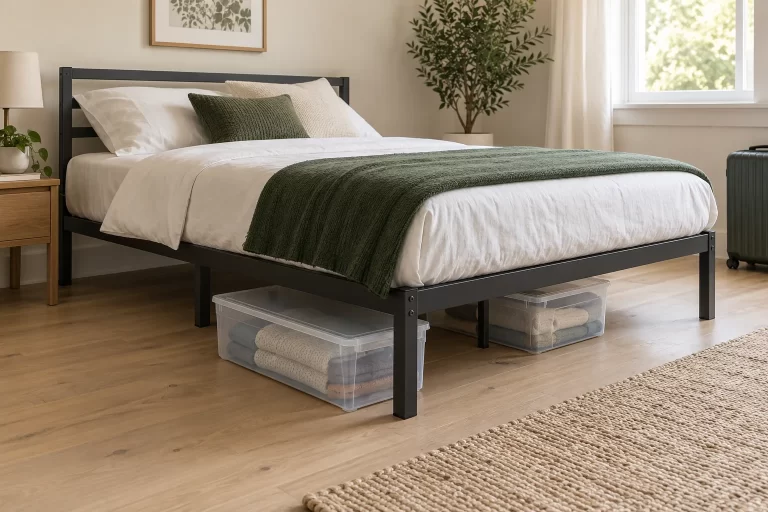
Underbed storage needs a separate set of measurements:
- Clear height: floor to the lowest rail, brace, or other obstruction along the bin’s route.
- Clear width and depth: space between legs and supports, not the full mattress footprint.
- Access space: enough room to pull out a drawer or bin without hitting a desk or your roommate’s furniture.
We measure the opening a storage box must pass through as well as the space where it will sit. A bin can fit under the middle of a bed yet fail to pass beneath the side rail.
Bed height, underbed clearance, and mattress thickness are different measurements. Our bed height calculator helps work out the finished sleeping height once you know the support height and the layers above it. For a shared room, sketch both bed frames and the desks first, then check doors, drawers, and the walking route.
Confirm your school’s furniture rules before planning on a replacement frame, risers, or a loft kit. Temple, for example, lists personal bed frames and mattresses among prohibited items and restricts bed-raising devices. The available setup is a housing-specific decision, not something the Twin XL label tells you.
Dorm Bed Size FAQs
Are all college dorm beds Twin XL?
No. Twin XL is common, but official housing information also lists standard Twins and other configurations. Temple and the University of Oregon publish different mattress lengths for different halls or floors. Confirm the bed in your assigned room.
Will regular Twin sheets fit a Twin XL dorm bed?
A standard Twin fitted sheet is intended for a shorter mattress and should not be assumed to fit an 80-inch Twin XL. Choose a fitted sheet explicitly sized for the assigned mattress. A Twin/Twin XL label on a comforter does not establish the fit of a separate sheet set.
What size is a dorm bed in centimeters?
A common retail Twin XL is approximately 97 × 203 cm. A 36 × 80-inch campus mattress is approximately 91 × 203 cm. Standard retail Twin is approximately 97 × 191 cm. Check the school’s measurements to identify which applies.
How thick is a dorm mattress?
There is no single thickness that applies to every dorm. Ask for your supplied mattress’s depth or measure it directly. If you add a topper under the fitted sheet, include its thickness when checking the sheet’s fit range.
Is a dorm bed the same size as a Full bed?
Not usually when the assigned bed is Twin or Twin XL. A common Full is 54 inches wide and 75 inches long: wider than Twin XL but shorter. Use Full bedding only when your housing information confirms the appropriate mattress dimensions.
Can I bring my own mattress or bed frame?
That depends on the university and housing type. Some schools supply both and prohibit personal replacements. Check the current move-in rules before buying a mattress, frame, or bed-raising accessory.
For a dorm bedding list that fits, start with the assigned mattress’s width, length, and thickness. Then account for your topper, match the fitted layers, and use the frame’s outside dimensions to plan the room. Those few numbers are more useful than assuming every college bed follows one standard.