5 Best Murphy Beds for Small Spaces: Find Your Fit
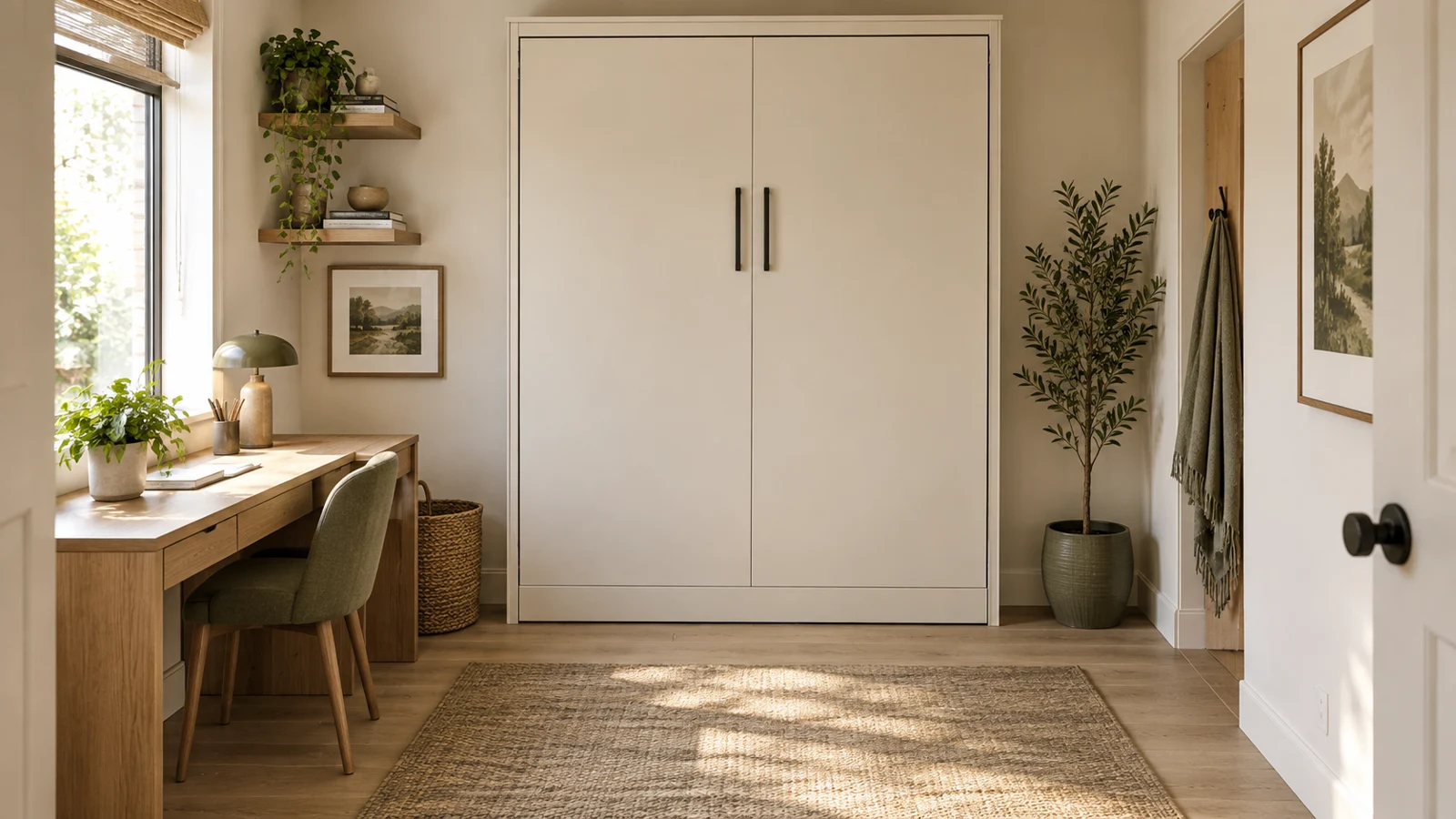
The best Murphy beds for small spaces make a room useful in two different ways: somewhere to work, read, or move around during the day, and somewhere to sleep at night. Finding the right one starts with the room’s shape. A narrow cabinet can still open too far into a small office, while a low horizontal wall bed can require more wall width than you have available.
Our five picks cover three approaches: a low cabinet with a folding mattress, a vertical wall bed, and a horizontal wall bed. We compare the exact configurations below by their closed dimensions, open depth, mattress requirements, and storage features. For an occasional guest room, we would start with the AFI Hamilton. For a shallow room with a wide clear wall, the Full horizontal Bestar Claremont deserves a closer look.
Best Murphy Beds for Small Spaces at a Glance
We would decide on bed type and sleeping size first, then compare the furniture’s measurements. Three picks include Queen folding mattresses; the two wall beds use separately purchased Full mattresses. That difference affects both room fit and the total setup you are buying.
| Product | Best For | Deciding Detail | Main Tradeoff | Skip If |
|---|---|---|---|---|
| AFI Hamilton Queen | Best Cabinet Bed with Storage | Included mattress, drawer and charging | Cabinet conversion and the supplied folding mattress | You want to use a conventional one-piece mattress in the bed |
| Night & Day Murphy Cube Queen | Best Low-Profile Cabinet | 36.6-inch closed height | Wider and deeper closed than the AFI cabinets | Your cabinet space cannot accommodate 64.1 inches of width and 26.4 inches of depth |
| Bestar Claremont Full Vertical | Best for Narrower Walls | Narrower 58.4-inch wall cabinet | Longer open projection; installed wall bed | You cannot provide the required wall-and-floor attachment or 86.2-inch projection |
| Bestar Claremont Full Horizontal | Best for Shallow Rooms | About 22.5 inches less projection than Vertical | Needs a much wider clear wall | Your usable wall cannot accommodate the 79.41-inch cabinet |
| AFI Southampton Queen | Best Grey Cabinet Option | Grey finish with the Hamilton-sized storage package | Same footprint as Hamilton | You are choosing it to save floor space compared with Hamilton |
On a phone, swipe the table to compare the deciding detail, tradeoff and skip condition.
All dimensions below are in inches. Closed measurements use width × depth × height. Open depth runs from the back of the unit to its furthest point when unfolded; it does not include a walking aisle. Compare the selected bed-only configuration rather than a wider bundle with attached shelving.
The quickest way through our list is to ask what your room needs most. Choose Hamilton for a cabinet with bedding storage, Cube for a lower cabinet profile, vertical Claremont for a narrower wall, or horizontal Claremont for less projection into the room. Southampton is a gray cabinet alternative to Hamilton, with the same listed footprint.
Affiliate disclosure: As an Amazon Associate we earn from qualifying purchases. Read our affiliate disclosure.
In this guide
Cabinet, Vertical, or Horizontal: Which Fits Your Room?
Cabinet Murphy beds store a folding mattress inside a low chest. Our three cabinet picks do not require wall anchoring according to their product specifications. They suit a guest room that should feel like an ordinary office or sitting room between visits. Allow space to unfold the bed and somewhere for any items that need to come off the cabinet.
Vertical wall beds fold down with the head of the mattress near the wall. Their cabinets use less wall width than a comparable horizontal bed, but the open bed reaches farther into the room. We would consider this arrangement when the wall is narrow and the opposite side of the room can remain clear.
Horizontal wall beds fold sideways, so the mattress’s length runs along the wall. This reduces open projection and cabinet height while increasing the width of the installation. It can work well beside a desk positioned at the end of a long room. Check the whole layout: a shallower bed still needs an unobstructed opening path and access alongside the mattress.
Before You Choose
- Cabinet or wall bed? Decide whether the mattress must fold with the cabinet or can remain a conventional mattress.
- Which dimension is limiting? Compare clear wall width with the fully open bed projection.
- Can the room support the required installation? Plan the exact attachment and mattress package before arranging furniture.
Our Five Murphy Bed Picks
1. AFI Hamilton Queen
Hamilton · Queen · White
We recommend AFI Hamilton Queen for its included mattress, drawer and charging.

Key Details
- Selected configuration
- Hamilton · Queen · White
- Closed cabinet (W × D × H)
- Closed 62.5 W × 24.38 D × 40.75 H in
- Frame and mattress support
- Solid wood and veneer cabinet; folding bed system
- Open projection
- 80.13 in open depth
- Mattress and installation
- Included 6 in Queen folding mattress, drawer and two USB ports; no mounting required
Why We Picked It
Our choice for an occasional guest room that needs a complete sleeping setup and a place for spare bedding. Hamilton combines a Queen cabinet bed, an included 6-inch folding mattress, a storage drawer, and two USB ports in one piece of furniture. We like that combination for an office where adding a separate bed, bedding chest, and bedside charging table would crowd the room.
The white configuration measures 62.5 × 24.38 × 40.75 inches closed and reaches 80.13 inches deep when open. Its cabinet is just over two feet deep, so it still takes up meaningful floor space during the day. We would place it against a clear wall and keep the desk beyond the bed’s opening area, rather than relying on moving the desk every time guests arrive.
The drawer’s listed interior dimensions are 40.75 inches wide, 17.25 inches deep, and 8 inches high. That makes it useful for folded sheets or a light blanket; check your pillows and thicker bedding before treating it as their permanent storage spot. The built-in charging unit has a 9-foot cord, which gives some flexibility when planning around an existing outlet.
Hamilton uses solid wood and veneer, and its specifications state that mounting is not required. Assembly and nightly conversion are separate considerations: a freestanding cabinet still needs to be assembled, and the mattress needs to be unfolded before use. We would choose it for guest-room convenience when the included three-fold mattress suits the intended sleeper.
Our room-fit take: Hamilton earns its place through the combined bed, storage, and charging functions. If your current guest bedding already has a home and a lower cabinet matters more, compare the Cube before choosing.
Pros
- Includes a Queen 6-inch folding mattress.
- Bedding drawer and two USB ports reduce the need for extra furniture.
- Does not require wall mounting.
Cons
- Uses a folding mattress rather than your existing conventional Queen mattress.
- Needs about 80.1 inches of open depth, plus access space.
Who Should Skip This
Skip this bed if you want to use a conventional one-piece mattress in the bed. Compare Claremont Vertical or Horizontal with a mattress matching that exact mechanism.
2. Night & Day Murphy Cube Queen
Murphy Cube · Queen · Cherry
We recommend Night & Day Murphy Cube Queen for its 36.6-inch closed height.

Key Details
- Selected configuration
- Murphy Cube · Queen · Cherry
- Closed cabinet (W × D × H)
- Closed 64.1 W × 26.4 D × 36.6 H in
- Frame and mattress support
- Solid hardwood cabinet; flat-pack assembly
- Open projection
- 80.3 in open depth
- Mattress and installation
- Included 6 in tri-fold gel memory foam mattress; no wall anchoring required
Why We Picked It
Our pick when a tall wall-bed cabinet would dominate the room. The Murphy Cube’s closed height is 36.6 inches, lower than the two AFI cabinets in this roundup. In the Cherry finish, it reads more like a low wood storage chest than a floor-to-ceiling installation. We would consider it for a small sitting room or office where keeping the upper wall visually open matters.
Its lower height comes with a different footprint. The Cube measures 64.1 inches wide and 26.4 inches deep when closed, making it both wider and deeper than Hamilton. Open depth is 80.3 inches, so it does not meaningfully shorten the space needed for an unfolded Queen bed. We would select it for cabinet height and wood styling, rather than assuming that “Cube” means the smallest option in every direction.
The specified configuration includes a 6-inch tri-fold gel memory foam mattress and a solid hardwood cabinet. It arrives flat packed for assembly. The product description says wall anchoring is not needed, giving it a different installation requirement from the two Bestar wall beds. That can be useful when a permanent wall-and-floor installation does not suit your room.
We would also think through the conversion routine. A low chest is an inviting place to leave books, framed photographs, or a lamp, but the bed still has to unfold. Keep the top lightly styled and plan a nearby landing place for anything that needs moving. A room works better when guest-bed preparation takes a few deliberate steps instead of a furniture reshuffle.
Our room-fit take: choose Cube for a low profile and warm wood finish. Choose Hamilton if a narrower cabinet, a dedicated drawer, and charging ports are higher priorities.
Pros
- Lower closed cabinet height than our AFI picks.
- Solid hardwood construction and included folding mattress.
- No wall anchoring required for this configuration.
Cons
- Wider and deeper when closed than Hamilton or Southampton.
- Flat-pack assembly and folding-bed setup are still required.
Who Should Skip This
Skip this bed if your cabinet space cannot accommodate 64.1 inches of width and 26.4 inches of depth. Compare the narrower Hamilton if its taller cabinet fits.
3. Bestar Claremont Full Vertical
Claremont · Full Vertical · White
We recommend Bestar Claremont Full Vertical for its narrower 58.4-inch wall cabinet.

Key Details
- Selected configuration
- Claremont · Full Vertical · White
- Closed cabinet (W × D × H)
- Closed approx. 58.4 W × 19.5 D × 80.6 H in
- Frame and mattress support
- Flexible slats and dual-piston mechanism; wall-and-floor attachment
- Open projection
- 86.2 in open depth
- Mattress and installation
- Separate 54 × 75 in mattress; 8–10 in thick and 60–90 lb
Why We Picked It
Our wall-bed choice when width is the limiting dimension. The white Claremont Full vertical cabinet is approximately 58.4 inches wide, considerably narrower than the horizontal Full version. We would consider it for a room with a clear stretch of wall between a doorway and a corner, provided the open bed has enough room to extend forward.
The full cabinet dimensions are approximately 58.4 × 19.5 × 80.6 inches closed, with 86.2 inches of open depth. That open measurement is the important one in a compact office. A desk directly opposite the cabinet can leave too little space when the bed is down, even if the daytime arrangement looks generous.
This bed takes a 54 × 75-inch Full mattress, purchased separately. The specified range is 8–10 inches thick and 60–90 pounds. We would check all three measurements before choosing a mattress: nominal size alone does not establish compatibility with the folding mechanism. The support uses flexible slats, and a dual-piston mechanism assists opening and closing.
The ability to choose a compatible conventional mattress makes this a useful option when you want more control over the sleep surface. It is also a different purchase from a cabinet-and-mattress package: add the mattress and installation to your comparison. Bestar requires attachment to both wall and floor structure, with two people and a professional or qualified installer. Plan that work before arranging the rest of the room.
Our room-fit take: this is a width-saving choice, not the shortest open bed in our lineup. In a room with more clear wall than floor depth, we would compare the horizontal version next.
Pros
- Narrower cabinet than the horizontal Full Claremont.
- Lets you select a compatible conventional Full mattress.
- Dual-piston mechanism and flexible slat support.
Cons
- Mattress is separate, and wall-and-floor attachment is required.
- Extends about 86.2 inches into the room when open.
Who Should Skip This
Skip this bed if you cannot provide the required wall-and-floor attachment or 86.2-inch projection. Compare Claremont Horizontal for less projection, or a cabinet bed for a different installation.
4. Bestar Claremont Full Horizontal
Claremont · Full Horizontal · White
We recommend Bestar Claremont Full Horizontal for its shallower open projection than the vertical model.

Key Details
- Selected configuration
- Claremont · Full Horizontal · White
- Closed cabinet (W × D × H)
- Closed 79.41 W × 19.53 D × 58.44 H in
- Frame and mattress support
- Mesh support and dual-piston mechanism; wall-and-floor attachment
- Open projection
- 63.68 in open depth
- Mattress and installation
- Separate 54 × 75 in mattress; 8–10 in thick and 35–70 lb
Why We Picked It
Our first wall-bed option to examine when the opposite wall feels too close. The white Full horizontal Claremont opens to a depth of 63.68 inches. Compared with the Full vertical version above, that is approximately 22.5 inches less projection into the room. In an office, that difference could determine whether a desk can stay in place overnight.
The exchange is wall width. Its cabinet measures 79.41 × 19.53 × 58.44 inches closed, about 21 inches wider than the vertical Full. We would measure the entire uninterrupted wall, including the space near door trim and fixed furniture, before choosing this layout. The lower cabinet height is useful visually, but it does not replace the model’s installation-clearance requirements.
This version also uses a standard 54 × 75-inch Full mattress, but its specified mattress weight is 35–70 pounds, with an 8–10-inch thickness. That is different from the vertical bed’s 60–90-pound range. We would select the mattress for this exact horizontal model rather than carrying over a recommendation from another Claremont configuration.
The bed has a mesh support base and dual-piston mechanism. Like the vertical version, it requires attachment to wall and floor structure and does not include the mattress. Its most convincing advantage for our readers is the geometry: the bed’s long side runs along the wall, leaving more of the room’s depth available when it is open.
Our room-fit take: a strong candidate for a wide, shallow room. Measure the route around the open bed as well as the rectangle it occupies; saving depth is only useful if the room still works at night.
Pros
- Approximately 22.5 inches less open depth than the Full vertical version.
- Lower cabinet profile at about 58.4 inches high.
- Accommodates a compatible conventional Full mattress.
Cons
- Requires about 79.4 inches of clear cabinet width.
- Mattress and a planned wall-and-floor installation are needed.
Who Should Skip This
Skip this bed if your usable wall cannot accommodate the 79.41-inch cabinet. Compare Claremont Vertical only if the room can provide its longer open depth.
5. AFI Southampton Queen
Southampton · Queen · Grey
We recommend AFI Southampton Queen for its grey finish with the Hamilton-sized storage package.

Key Details
- Selected configuration
- Southampton · Queen · Grey
- Closed cabinet (W × D × H)
- Closed 62.5 W × 24.38 D × 40.75 H in
- Frame and mattress support
- Solid wood and veneer cabinet; folding bed system
- Open projection
- 80.13 in open depth
- Mattress and installation
- Included 6 in Queen folding mattress, drawer and two USB ports; no mounting required
Why We Picked It
Our alternative to Hamilton when the gray finish and cabinet detailing better suit your room. Southampton provides the same practical combination of a Queen folding bed, 6-inch included mattress, storage drawer, and two USB ports. We would compare these two AFI models side by side before buying, especially if your office already has painted furniture.
The listed dimensions are identical to Hamilton: 62.5 × 24.38 × 40.75 inches closed, extending to 80.13 inches deep when open. The drawer dimensions and 9-foot charging cord are also the same. This makes Southampton a style choice within the same basic space requirement; it does not free up extra floor area compared with Hamilton.
The gray cabinet could work well alongside a pale desk, neutral walls, and simple bedside lighting. We would keep other furniture modest in size so the room remains easy to convert. A small movable side table may be more useful than a bulky permanent nightstand that sits inside the opening area.
As with Hamilton, the cabinet uses solid wood and veneer, and the specified version does not require mounting. Choose it when you want the included folding mattress and storage package, rather than the flexibility of selecting a conventional mattress for a wall bed. Compare the current offers for the exact finishes, since availability and pricing can change independently.
Our room-fit take: pick the finish you prefer once both models fit your measurements. Their matching dimensions make this an easier design decision than comparing two different bed types.
Pros
- Includes the Queen folding mattress, drawer, and USB charging.
- Gray finish offers a different look from our white Hamilton pick.
- Does not require mounting.
Cons
- No footprint advantage over Hamilton.
- The included folding mattress determines the basic sleep setup.
Who Should Skip This
Skip this bed if you are choosing it to save floor space compared with Hamilton. Their listed dimensions match. Choose by finish once both fit, or compare Horizontal Claremont for a different opening geometry.
How to Measure a Small Room for a Murphy Bed
When choosing the best Murphy beds for small rooms, we start with a tape measure and a simple floor outline. Measure the room as it will be used at night, including the furniture you intend to keep in place. Our room-planning guide can help you organize the surrounding furniture.
Measure the usable wall
Record the clear width between fixed obstacles. Door trim, a radiator, a built-in cabinet, and a window that needs access can all reduce the available space. Use the bed’s outside cabinet width rather than its mattress width or the rounded number in its product name. A “59W” product name is a useful identifier, but the assembled dimensions are better for planning.
Mark both closed and open outlines
Use removable tape to mark the cabinet footprint, then extend the outline to the listed open depth. Start both measurements from the same back edge. Open depth already describes the full projection; do not add the cabinet depth to it a second time. For a wall bed, account for the final mounting position and follow the installation drawing where trim or wall details affect placement.

Our Full Claremont comparison illustrates the trade-off. The horizontal cabinet is wider, but its bed projects less far forward. The diagram shows product outlines only. It does not assign a walking aisle or assume that either layout fits every room with the same floor area.
Keep the night-time route usable
Open the room door and wardrobe doors over the taped layout. Pull out the desk chair and imagine walking from the doorway to the bed. A cabinet can fit mathematically while leaving a frustrating route around its foot. Bestar’s vertical listing suggests allowing 30–36 inches around the open bed for easier access; consider that alongside your room’s actual arrangement and the selected model’s instructions.
We would pay particular attention to an office chair opposite the bed. If the chair must move, give it a specific overnight position. The same applies to a small table, laundry basket, or floor lamp. Planning where these items go makes the room easier to convert repeatedly.
Check height and installation space
Measure ceiling height, slopes, ceiling fixtures, and anything above the cabinet. Cabinet height and minimum installation height are different measurements: assembly may need additional clearance. Check the instructions for the exact size and model before ordering. For the fixed Bestar options, confirm the wall and floor attachment locations as part of that same plan.
Mattress and Setup Details That Change Your Choice
Start with the complete sleeping package
Hamilton, Cube, and Southampton include 6-inch folding mattresses. We would compare those as complete cabinet-bed packages. The two Claremont wall beds take separate conventional Full mattresses, giving you more choice within the stated specifications. Their advertised furniture price therefore does not describe the whole sleeping setup.
For occasional guests, an included mattress can simplify the decision. For frequent use, we would put more time into choosing a mattress with the desired feel and the correct support requirements. Either way, personal comfort depends on the mattress and sleeper; a product’s folding direction alone does not determine how comfortable it will be.
Match size, thickness, and weight
| Bed | Mattress | Thickness | Mattress weight |
|---|---|---|---|
| AFI Hamilton / Southampton | Queen folding; included | 6 inches | Use specified folding replacement |
| Night & Day Cube | Queen tri-fold; included | 6 inches | Use specified folding replacement |
| Claremont Full Vertical | Full 54 × 75; separate | 8–10 inches | 60–90 lb |
| Claremont Full Horizontal | Full 54 × 75; separate | 8–10 inches | 35–70 lb |
Check the mattress manufacturer’s actual dimensions and weight for the selected size. A product name such as “10-inch Full” does not tell you whether it falls within a particular lifting mechanism’s weight range. Neither Claremont configuration in this guide is intended to use a box spring or futon mattress. For a cabinet bed, retain the specified folding format and verify any replacement with the cabinet’s manufacturer.
Choose the installation that suits the room
Our cabinet picks do not call for wall anchoring. The two Bestar wall beds require attachment to structural wall and floor locations, with the installation arrangements described above. We would include that difference in the buying decision alongside furniture delivery, mattress cost, and assembly.
A guest room that changes purpose once a month may favor a complete cabinet package. A room that changes between office and bedroom every day may justify a fixed wall bed and a separately chosen mattress. Consider the steps you will repeat: clearing the opening area, moving small objects, preparing bedding, and returning the room to daytime use.
How We Selected Our Picks
We compared complete beds by room fit, mattress configuration, described support and folding systems, storage features, and the exact product versions available to buy. Our measurements draw on the selected product specifications and manufacturer information from AFI, Night & Day, and Bestar.
We kept hardware-only DIY kits out of the five picks because they require a different project and budget. We also separated Full wall beds from Queen cabinet packages. Our recommendations reflect how each configuration can serve a small room, rather than treating every Murphy bed as interchangeable.
Frequently Asked Questions
What type of Murphy bed works best in a small room?
We would choose by the room’s limiting dimension. A vertical wall bed suits a narrower wall with enough clear floor depth in front. A horizontal wall bed uses more wall width but opens less far forward. A cabinet bed suits a low furniture arrangement and an included folding mattress. Start with the open outline, then check the closed cabinet and installation requirements.
Is a horizontal Murphy bed better for a small space?
It can be better for a shallow room, but it needs a wider clear wall. In our Full Claremont comparison, the horizontal version opens about 22.5 inches less far into the room while its cabinet is about 21 inches wider. We would choose it when that exchange preserves useful access or lets a desk remain in place. A narrow wall may favor the vertical version instead.
How much room does a Murphy bed need when open?
Use the exact product’s open depth and width, then add the space you need to enter the bed and operate nearby furniture. Our picks extend approximately 63.7–86.2 inches from their backs when open. Those figures describe the furniture, not the complete working layout. Include door swings, wardrobe access, and any desk chair that will stay in the room overnight.
Can we use a regular mattress on a Murphy bed?
The two Bestar wall beds in this guide take conventional Full mattresses within their specified size, thickness, and weight ranges. The vertical and horizontal models have different weight requirements. Our cabinet picks include folding mattresses that store inside their chests; a regular one-piece mattress is not an equivalent replacement. Match the mattress to the exact bed mechanism and support specifications.
What is the difference between a Murphy cabinet bed and a wall bed?
A cabinet bed stores a folding mattress in a low chest that opens into a sleeping platform. A wall bed stores its mattress vertically or horizontally inside a taller or wider cabinet attached to the room’s structure. Our cabinet picks do not require wall anchoring, while our Bestar wall-bed picks require wall-and-floor installation. We would compare them as different furniture solutions, even though both are often called Murphy beds.
Our Recommendation
We would start with Hamilton for a Queen guest-bed package with storage, vertical Claremont for a narrower wall, and horizontal Claremont for a shallow room. Choose Cube for its lower wood cabinet or Southampton for a gray alternative to Hamilton. The best choice is the one whose open layout works as well as its closed appearance.