What Is a Bunkie Board? Uses, Types & When You Need One
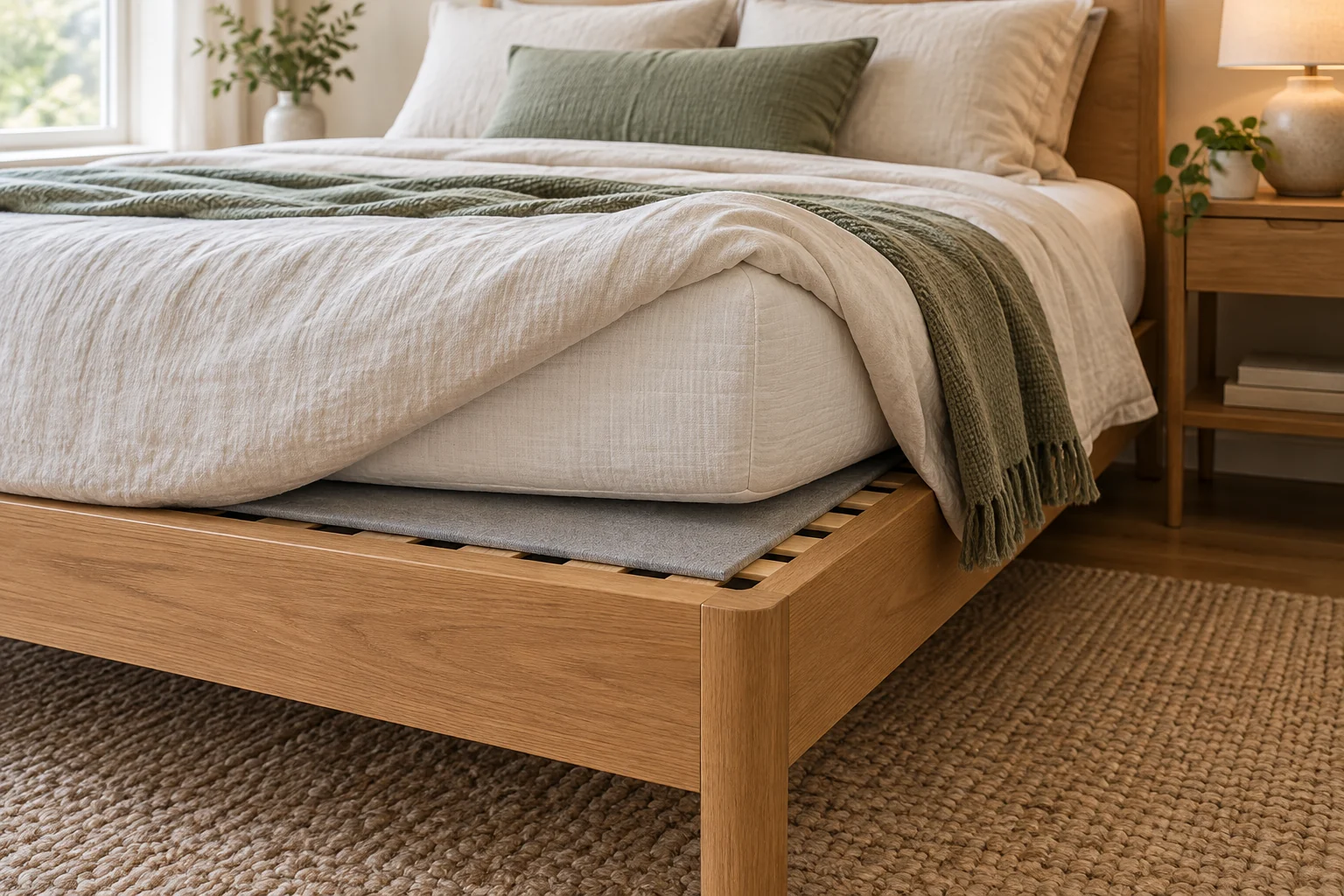
A bunkie board is a low-profile mattress support placed between a mattress and the bed structure underneath it. It can provide a suitable support surface without adding a thick foundation. Some boards are solid or composite overlays; others use slats in a fixed frame. The construction determines what must support the board from below.
If your mattress already rests on an approved, properly supported platform, you may not need another layer. We start with that question, then look at the board’s structure, actual fit, and effect on bed height. The right choice depends on the mattress, the board, and the frame working together.
Do You Need a Bunkie Board?
Before buying, lift the mattress and identify what supports it. Our quick check separates a missing support surface from a damaged bed.
| What you have | Our starting point | What to check |
|---|---|---|
| A platform that meets your mattress requirements | Skip the extra layer unless the manufacturer specifies one. | Approved surface, load limit, and center support. |
| Sound slats with gaps your mattress does not allow | Consider an approved overlay or a compatible slat upgrade. | Board span, mattress approval, and support beneath it. |
| An open frame designed for a foundation | Choose a support unit approved for that frame. | Supporting ledges, center structure, and required floor legs. |
| Broken slats, a bent rail, or a missing center leg | Fix the structure first. | A board cannot restore a damaged frame’s capacity. |
| An adjustable base | Use the base as its instructions specify. | Do not bridge moving sections with an unapproved rigid board. |
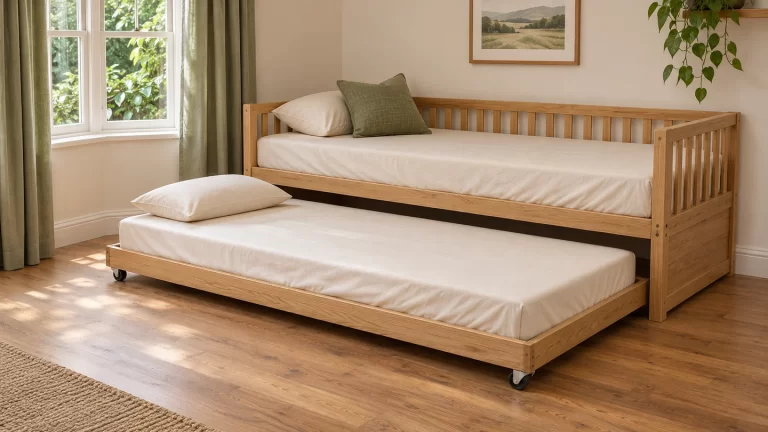
| A bunk, daybed, or trundle | Check the bed’s approved setup before adding height. | Combined thickness, upper-bunk clearance, or space to roll the trundle closed. |
Swipe inside the table to see all columns.
In this guide
What Is a Bunkie Board, and Where Does It Go?
A bunkie board adds a shallow support layer directly beneath the mattress. You may also see the spelling bunky board. Neither name identifies a single material, thickness, or method of installation.
In an overlay setup, the order is mattress, board, existing slats or bars, then the supporting frame and legs. A different board may have its own rigid frame and be approved to rest on a bed’s ledges and center supports. You cannot assume those arrangements are interchangeable.

A bunkie board is not a mattress topper. A topper goes above the mattress to change its surface feel; the board works underneath it. It is also not a bed frame: it does not supply the complete rails, joints, and floor support that carry the bed.
Our bed parts guide can help you identify those components before choosing an extra layer.
The Two Main Constructions to Check Before Buying
Look first at how a product is supported. A fabric cover can hide very different structures, and “bunkie board” alone tells you little about what the product can span.
Overlays that need existing support
These lie over an existing platform, slats, or bars. Their purpose is to change the surface immediately beneath the mattress. They still rely on the bed below and have limits on the openings they can bridge.
Some fold into sections for handling. Folding does not establish strength or compatibility; check the specified installation and support spacing for that exact version.
Framed or structural support inserts
Other products combine a perimeter frame with slats or a deck. Some can replace a foundation on a compatible bed, provided the bed supplies the required ledges and center support. Others still need additional support underneath.
Also check the surface itself. A fixed slatted board still has gaps, while a continuous panel covers them. Neither “wood” nor “metal” guarantees that the surface meets your mattress requirements.

How to Check Size, Support, and Finished Bed Height
Measure the place where the board will sit
Match the mattress size, but also measure the bed. “Queen” is a category, not a promise that every Queen board fits every Queen frame.
- Interior length and width: measure between the rails at the board’s intended position.
- Supporting ledges: identify where the board or insert must bear on the frame.
- Actual product dimensions: compare the listed measurements with the opening and installation instructions.
- Split pieces: check their orientation and whether each piece has the required support.
A board that is too large may sit on the rail rather than its intended ledge. One that is too small may lose necessary bearing. Do not treat a close-looking size as a confirmed fit.
Check the mattress rule and the board’s support rule separately
There are two different gaps to think about: openings directly beneath the mattress, and openings beneath a board that bridges them. The board’s permitted span is not automatically the mattress manufacturer’s approval of the whole arrangement.
For example, Sleep On Latex’s support guidance recommends a platform base or slatted foundation with gaps of 3 inches or less for its mattresses. Treat that as brand-specific guidance, then check the board and frame you plan to use. Avoid turning one brand’s number into a rule for every mattress.
Check slat width, attachment, and center support as well. A center beam is different from a leg that reaches the floor. Keep required legs in place, and do not assume an added panel increases the bed’s stated weight limit. If the frame itself is unsuitable, our bed frames for latex mattresses guide explains support-focused alternatives.
Add every layer when calculating bed height
Use the height of the support surface above the floor—not the headboard height or the top of a decorative rail.
For an illustrative setup with a 7-inch support height, a 1.5-inch board, and a 12-inch mattress, the finished height is 20.5 inches. If the mattress and frame allow replacing an 8-inch foundation with that 1.5-inch board, the same setup becomes 6.5 inches lower. Simply adding the board on top of the existing foundation would instead raise it.

Use our bed height calculator to compare setups. On a trundle, also measure the closed clearance. On an upper bunk, count the added layer when checking the bed’s permitted thickness and guardrail clearance; CPSC specifies at least 5 inches between the mattress top and guardrail top, alongside the bed’s other requirements.
Meliusly Original Bunkie Board — Queen
The Meliusly Original Queen illustrates a low-profile overlay: the gray version measures 60 × 80 × 0.4 inches and requires existing support underneath.
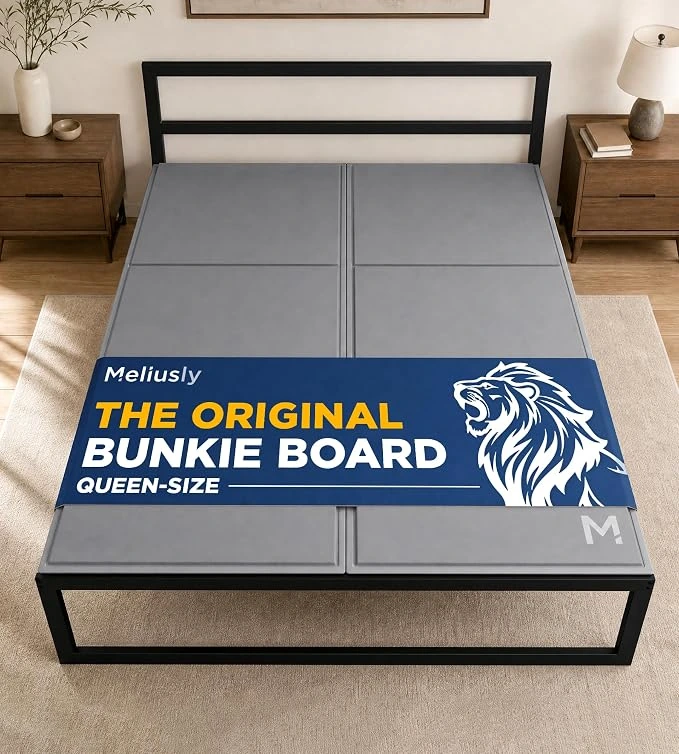
Its twin-wall polypropylene construction and fabric cover differ from a framed wood foundation. We would consider it where the mattress allows this arrangement and the existing structure meets the board’s span requirements.
Pros
- Adds about 0.4 inch of height.
- Folds for handling; silicone-grip underside.
Cons
- Requires support below it.
- Cannot repair a damaged bed structure.
Who Should Skip This
Skip it for an empty rail frame, missing support legs, or a mattress that does not allow this type of overlay.
Bunkie Board vs. Box Spring, Foundation, and Slats
These terms are often mixed together in listings. Check construction and purpose rather than relying on the label.
| Support | What it provides | The deciding check |
|---|---|---|
| Bunkie board | A shallow mattress-support layer; may be continuous or slatted. | Does it need existing support, or is it approved for the frame’s ledges? |
| Traditional box spring | A framed unit containing springs. | Does the mattress permit spring-based support? |
| Rigid foundation | A boxed support unit without traditional springs; adds its own height. | Frame fit, center support, and mattress compatibility. |
| Bed slats | Spaced supports forming part of the bed’s mattress platform. | Gap, width, attachment, and required support beneath them. |
Swipe inside the table to see all columns.
A bunkie board replaces a box spring or foundation only when both the mattress and bed permit that exact replacement. A thin overlay cannot automatically span an open foundation-style frame. If your setup still calls for a separate foundation, see our box spring installation guide.
How to Add One to a Compatible Bed
Once the combination is approved, use the board’s instructions for the details. Our basic sequence is:
- Remove the mattress and inspect the frame. Check rails, joints, slats, and support legs before covering them.
- Confirm the measurements and support points. Compare the board’s actual size and permitted span with the bed.
- Keep every required support. An overlay normally leaves the necessary slats or bars underneath. Remove an old foundation only if the replacement arrangement is approved.
- Position and assemble the board as directed. Align split pieces and install any specified fasteners. Do not assume all boards are tool-free.
- Replace the mattress and recheck the fit. Confirm full bearing, no unsupported edges, and the intended finished height.
For an adjustable bed, start with the base manufacturer’s instructions rather than adding a rigid panel across its moving deck. Our adjustable-base frame guide covers the separate question of fitting a decorative frame around a base.
Bunkie Board FAQs
Do you need a bunkie board if you already have slats?
Only if the existing setup needs an approved change. Slats that already meet the mattress requirements may be sufficient. If they do not, compare a compatible overlay with an approved slat upgrade; adding a board is not automatically the better option.
Will a bunkie board fix a sagging mattress?
It may address an unsuitable support surface, but it cannot restore worn mattress material or fix a bent frame. Identify whether the dip comes from gaps, damaged supports, or the mattress itself before choosing a remedy.
Can you use plywood instead?
Only if the mattress and bed manufacturers allow that arrangement. Check material, thickness, span, edge finish, and ventilation requirements. We would not choose a universal plywood thickness without knowing the structure beneath it or the mattress it will support.
Can a bunkie board go directly on the floor?
That depends on the board and mattress instructions. A floor may provide continuous bearing, but it does not establish that the mattress permits that setup or has adequate moisture management. A raised frame also preserves access for cleaning and under-bed space.
Will it make the mattress firmer?
Changing an uneven or flexible base may change how the mattress feels. A board does not change the mattress’s foam or spring construction, though, so we would choose it for a support need rather than promise a specific firmness change.
Our Take
A bunkie board makes sense when it supplies an approved support surface your current bed lacks. If the existing platform already meets the mattress requirements, we would skip the extra layer. If the frame is damaged, we would fix that first. Choose the board only after confirming its size, what supports it, and the height of the finished bed.