How to Choose a Bed for a Small Room: A Practical Room-Fit Guide
Small-room buying guide
How to Choose a Bed for a Small Room
Choose the bed that produces the best complete room—not the largest mattress you can force between the walls. This guide combines sleeper needs, bed type, exact measurements and daily operating space into one decision process.
Reviewed and updated September 2026 · Independent, room-first guidance
The seven-step answer
- Decide who sleeps there and how often.
- Measure the room shell, openings and fixed obstacles.
- Set a comfortable walkway target before choosing mattress size.
- Choose the bed type that serves the room’s daytime function.
- Use exact assembled, open and operating dimensions.
- Tape the footprint and test doors, drawers and bed-making.
- Verify mattress, capacity, installation, delivery and return constraints.
Begin with the sleeper and frequency
Nightly primary sleep
Prioritize mattress choice, even support, easy access and durability. A storage bed or wall bed rated for frequent use may be appropriate.
Occasional guests
Conversion and storage matter more. Cabinet beds, rollaways, daybeds, trundles and sleeper chairs offer different setup/comfort balances.
One sleeper
Twin XL gives tall users Queen length at Twin width; Full adds width but not length. One-side wall placement may be practical.
Two sleepers
Queen is the common compact compromise. Preserve access on both sides where possible and verify combined support capacity.
Choose mattress size from usable clearance
| Size | Dimensions | Small-room strength | Tradeoff |
|---|---|---|---|
| Twin | 38 × 75 in | Maximum leftover floor | Short/narrow for some adults |
| Twin XL | 38 × 80 in | Long but narrow | Fewer frames and sheets than Twin |
| Full | 54 × 75 in | Generous for one adult | Short for tall users, tight for couples |
| Queen | 60 × 80 in | Compact couple standard | Can dominate rooms near 10 × 10 ft |
| King | 76 × 80 in | Maximum couple width | Uses 16 more inches of width than Queen |
| California King | 72 × 84 in | Extra length | Long footprint reduces foot clearance |
Use the calculator for the first pass. Then add the frame overhang and every moving part.
Match the bed type to the room problem
Need open floor?
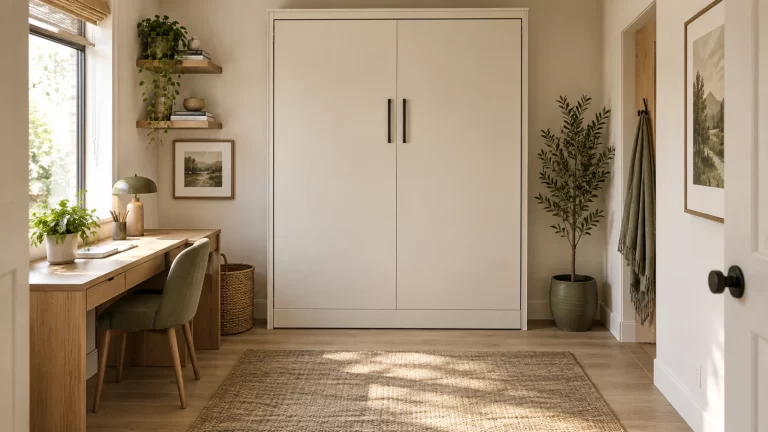
Compare Murphy beds, cabinet beds and rollaways.
Need storage?
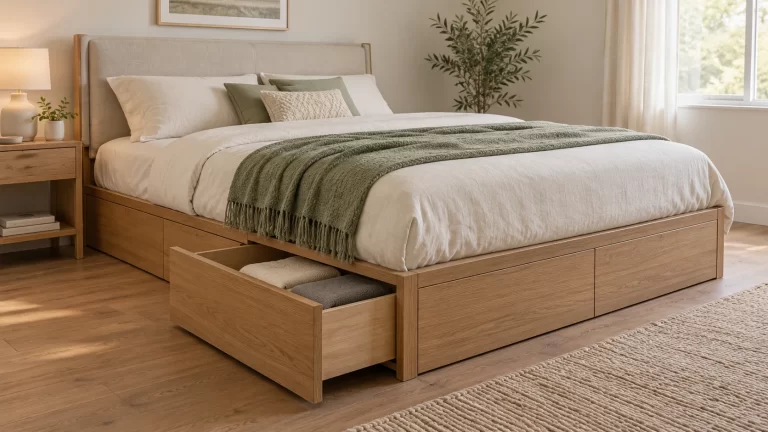
Compare drawer and lift-up storage beds, checking how access affects the aisle.
Need two guest spots?
A trundle provides two surfaces but needs a large nighttime pull-out zone.
Need seating?
Compare a daybed with a sleeper chair by closed and open use.
Need a desk below?
A loft bed uses height but adds ceiling, ladder and safety constraints.
Still unsure?
Use the complete bed-type comparison to eliminate options by installation and daily function.
A ten-minute physical fit test
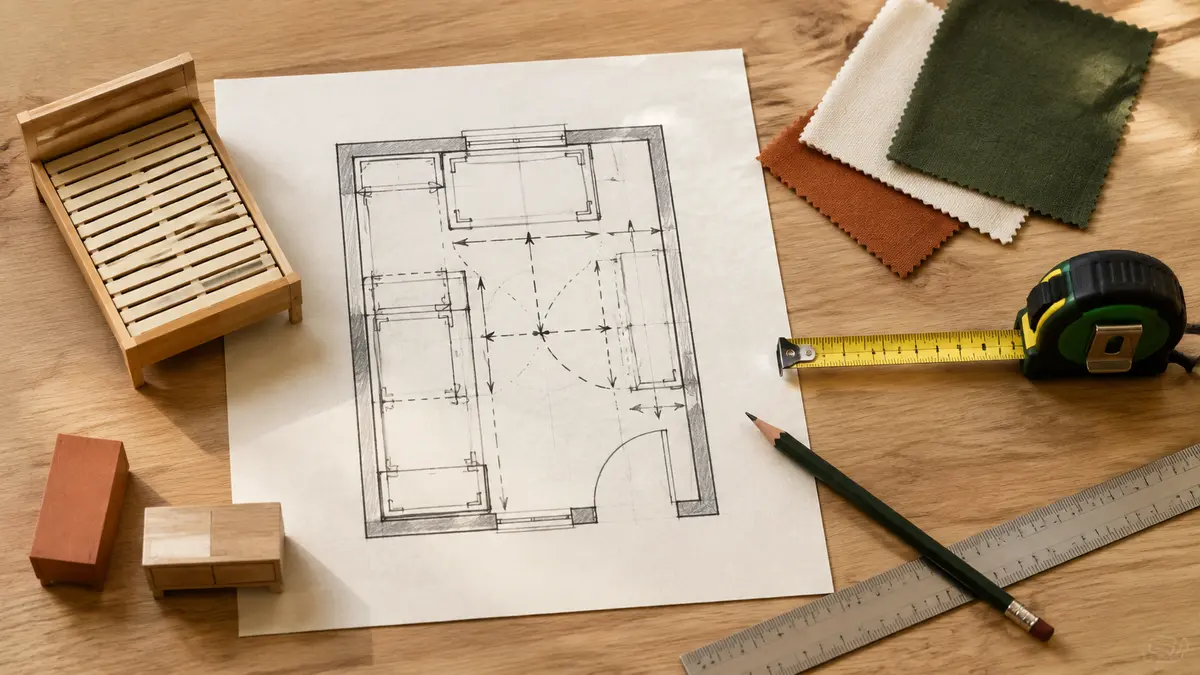
Tape the outer frame
Use assembled dimensions, not the mattress, and mark headboard and footboard projections.
Mark the open mechanism
Add drawers, the trundle, the wall-bed arc, sleeper-chair extension or ladder landing.
Walk the real route
Enter the room, reach the closet and approach the bed as you would in the dark.
Operate everything
Open doors and drawers, pull out a chair and simulate changing the sheets.
Check delivery backwards
Compare cartons and component sizes with doors, stairs, elevators and corners from the room to the entrance.
Choosing a small-room bed FAQ
Should I buy a Full or Queen for a small room?
A Full saves six inches of width and five inches of length, making it strong for one sleeper. A Queen is more practical for most couples if clear aisles remain.
Is the smallest bed always best?
No. The goal is the best complete room. A slightly larger storage bed may eliminate a dresser; a wall bed may return the floor during the day.
How much space should I leave around the bed?
Thirty inches is a useful comfortable target, while 24 inches is a compact passage. One-side access can work for one sleeper but changes usability.
Which bed is best for a small guest room office?
Murphy and cabinet beds recover more floor; sleeper chairs preserve seating; daybeds offer the simplest conversion. Choose by installation and guest frequency.
What dimensions should I trust?
Prioritize the current manufacturer’s assembled and open dimensions for the exact model and size. Retailer listings can confuse cartons, closed and open measurements.
What should I check before ordering?
Room fit, open operation, mattress compatibility, capacity, anchoring, package route, assembly help, warranty and return shipping.
Sizing and research method
- Sleep Foundation mattress-size reference — standard U.S. mattress dimensions.
- How We Research — our evaluation criteria and update process.
Make the room work before you buy
Measure the whole frame, preserve the operating space and compare the layout with how the room needs to function every day.
Use the room-fit calculator