How to Keep a Mattress From Sliding on a Bed Frame

A mattress that drifts toward one side of the bed can turn making the bed into a daily reset. When the frame stays put, the useful checks are above the legs: the mattress’s fit, the surface beneath it, and the parts that hold its edges in position.
In our guide to how to keep a mattress from sliding, we start with those checks, then explain when a grip pad or a correctly fitted retainer makes sense. Platform beds, fabric-covered foundations, and adjustable bases need different approaches.
Quick answer: Confirm that the mattress moves independently of the frame. Check its size against the usable support area, clean the contact surfaces as their makers direct, and inspect any built-in retainers. For a correctly supported mattress on a stationary base, a compatible under-mattress grip pad can add friction. An exposed metal rail may accept a clamp-on stop; an adjustable base needs its own model-specific retention check.
First, Check What Is Actually Sliding
Compare the mattress edge with the frame edge before and after normal use. Also watch the foundation and bed feet. That tells you which contact surface needs attention.
| What you see | Where to start |
|---|---|
| Mattress shifts; frame and feet stay put | Check mattress fit, underside grip, and mattress retainers. Follow the steps below. |
| Mattress and foundation shift together | Inspect the foundation-to-frame fit and its retaining edges. A pad above the foundation addresses a different layer. |
| The whole frame moves across the floor | Use our bed frame floor-sliding guide for feet, wheels, grippers, and caster cups. |
| Only the topper moves | Check topper-to-mattress contact and its fastening system. The mattress-to-frame connection may already be secure. |
In this guide
Match the Fix to Your Bed Base
Our starting point is the surface carrying the mattress. If your bed has an outer decorative frame around a separate adjustable base, inspect the moving base beneath the mattress, rather than choosing a clamp for the outer frame.
| Base type | First check | Useful next step |
|---|---|---|
| Stationary platform | Correct size, sound support, clean contact surfaces | A compatible grip pad directly beneath the mattress |
| Metal or wood slats | Slat condition, mattress support requirements, existing retaining lips | A permitted grip layer; compatible stops if the frame has suitable mounting points |
| Fabric-covered foundation | Whether the mattress or the entire foundation moves | A grip pad on the foundation only when the mattress is the moving layer |
| Adjustable base | Original bars, hooks, grip surface, and exact model instructions | Restore the factory retention setup; add a grip layer only where the makers permit it |
Swipe within the table to compare the columns.
Check Fit and Contact Surfaces First
- Measure the actual pairing. Compare mattress width and length with the usable support area or recessed opening. Decorative outside-frame dimensions do not tell you how closely the mattress fits.
- Inspect the support. Seat loose slats and tighten connections as the frame instructions specify. Broken slats, an unsuitable support layout, or a wrong-size mattress call for correcting that pairing before adding grip. Our bed parts guide identifies rails, slats, and other support components.
- Clean the two contact surfaces. Remove loose dust using the cleaning method allowed for the mattress underside and base. Let any damp-cleaned surface dry fully before putting the mattress back.
- Check recent changes. A new encasement, bed skirt, or smooth fabric layer changes what touches the support. Inspect that layer and any original fixed stops or grip system.
We treat friction and support as separate checks. A thin mesh gripper adds a contact layer; it does not turn widely spaced or damaged slats into a suitable foundation.
Use a Grip Pad Between the Mattress and Its Support
An under-mattress gripper sits between the mattress underside and the platform or foundation. A quilted mattress pad or protector usually fits over the mattress. Choose by placement and purpose, because the word “pad” appears on both types of product.

How to position a mattress grip pad
- Lift the mattress clear of the support surface.
- Lay out the permitted gripper flat, following its placement instructions. Keep it clear of any attachment points that need direct contact.
- Center it beneath the mattress. Trim only if the pad maker allows it.
- Lower the mattress into position without bunching the pad. Recheck the edges after making the bed.
Both Queen pads below measure 54 × 72 inches. Centered under a standard 60 × 80-inch Queen, that leaves 3 inches at each long side and 4 inches at each end. Neither publishes a numerical pad thickness, so we would choose between them by fit and care rather than a claimed height difference.
| Accessory | Where it goes | Key fit condition |
|---|---|---|
| Nevlers Queen grip pad | Between mattress and support | 54 × 72 inches; compatible underlay and contact surface |
| Gorilla Grip Queen gripper | Between mattress and support | 54 × 72 inches; hand-wash care |
| SHLAND six-piece stops | Clamped to exposed metal rails | Listing specifies 0.8–1.3-inch rail thickness; no round tubes |
| DELLAN Regular two-pack | Clamped to compatible metal rails | Rail under 1.55 inches across and 2.99 inches deep; seller shows 5-, 6-, and 8-inch mattresses |
Swipe within the table to compare the accessories.
Nevlers Queen Mattress Gripper Pad
We would start with this option when the mattress is correctly supported and the goal is to add friction without fastening hardware to the frame.

- Coverage
- 54 × 72 inches
- Installation
- Reversible, non-adhesive PVC foam pad
- Care
- Damp cloth or vacuum
Pros
- No adhesive or tools needed.
- Can be trimmed to fit.
Cons
- Does not cover a Queen edge to edge.
- Numeric thickness is not provided.
Who Should Skip This: Choose another approach if you need a rigid support panel or your mattress/base instructions exclude this type of underlay. Nevlers’ placement and care guidance explains the intended contact layer.
Gorilla Grip Queen Mattress Gripper
Gorilla Grip is an alternative with the same Queen footprint and explicit hand-wash instructions. Its textured, open-weave surface contacts both the mattress and support beneath it.

- Coverage
- 54 × 72 inches
- Installation
- Dual-sided gripper; trim with scissors
- Care
- Hand wash only
Pros
- Clear platform and box-spring placement instructions.
- Can be trimmed for an inset fit.
Cons
- Hand washing takes more effort than wiping.
- Numeric thickness is not provided.
Who Should Skip This: Skip it if you need machine-wash care or a solution for the frame moving on the floor. Follow Gorilla Grip’s under-mattress placement instructions for this product.
Add Mattress Retainers Only When the Mounting Fits
A retainer gives the mattress edge a physical stop. A clamp-on version needs an exposed rail that matches its opening and leaves room for the fasteners. The bed’s Queen or King label tells you little about that connection.
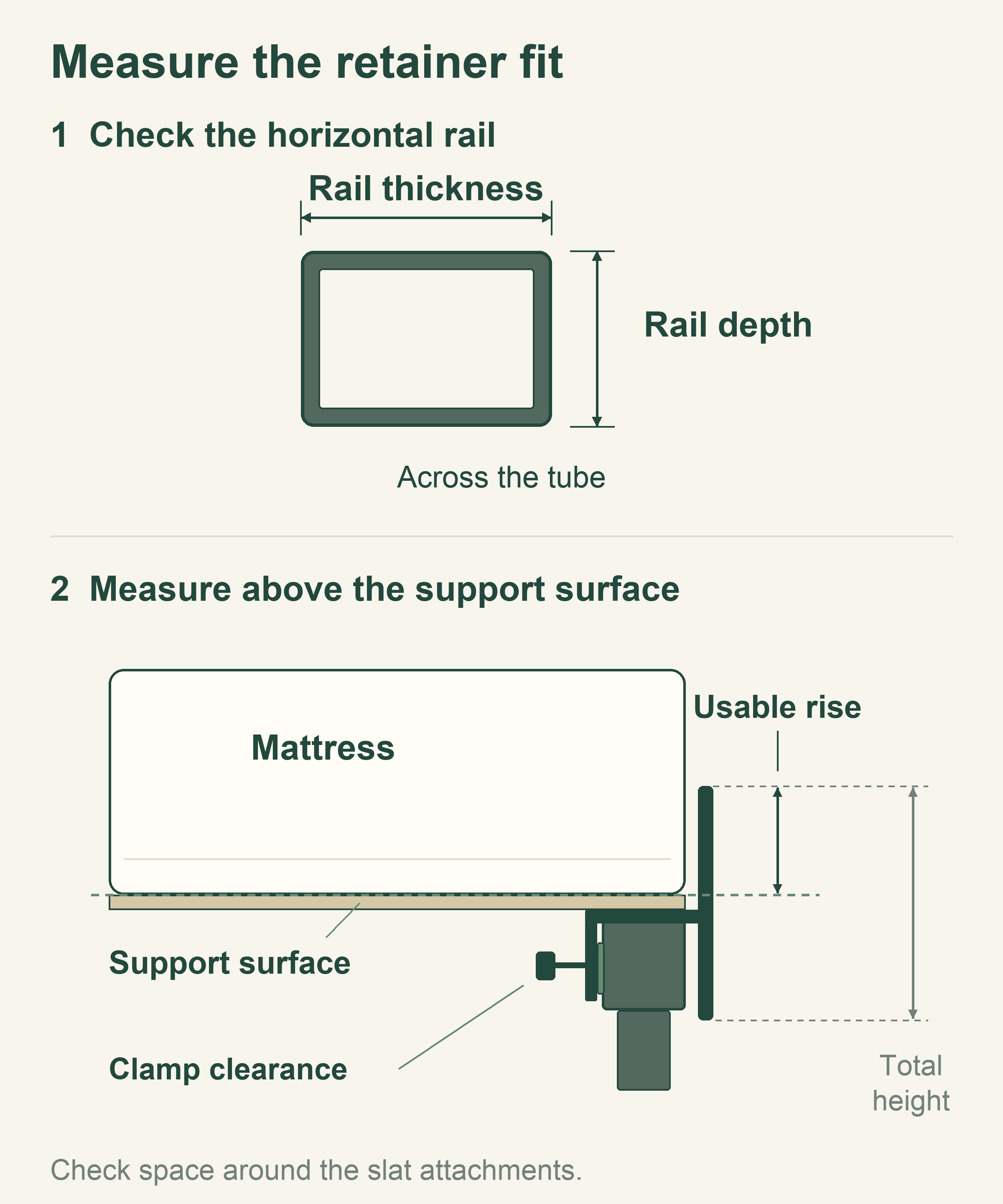
Measure rail thickness from the outside face toward the inside of the bed and rail depth from top to bottom. Then check access around slat attachments and the inside screw or backing plate. Finally, compare the retainer top with the actual slat or platform surface: it needs to overlap the lower mattress sidewall. It does not need to reach the mattress top.
SHLAND Six-Piece Mattress Stops
We would consider this removable set for a stationary metal frame after checking rail shape, thickness, and clear mounting locations.

- Quantity
- Six separate stops
- Rail thickness
- Listing: 0.8–1.3 inches; not round tubes
- Attachment
- Top hook, inner plate, hand screw
The product text and picture heading specify 0.8–1.3 inches; an internal picture label shows a different minimum. We use the narrower 0.8–1.3-inch range when screening fit. Its 3.1-inch overall height does not establish the rise above your slats.
Pros
- Six stops allow separate side and foot placement.
- Hand-tightened, removable attachment.
Cons
- Conflicting minimum-width picture label.
- Installed rise above the support is unspecified.
Who Should Skip This: Skip it for round rails, enclosed or padded rails, obstructed clamp positions, or an adjustable base without specific compatibility confirmation.
DELLAN Regular Retainer Bar, Two-Pack
This is a restricted alternative: the seller’s fit picture lists 5-, 6-, and 8-inch mattresses. We would keep the Regular version within that published setup.

- Rail limits
- Under 1.55 inches across; under 2.99 inches deep
- Mattress heights shown
- 5, 6, and 8 inches
- Attachment
- Bolted clamps; tools included
Pros
- Both rail dimensions are specified.
- Broad stops with removable clamps.
Cons
- Limited mattress-height guidance.
- Needs access around both clamp assemblies.
Who Should Skip This: The seller excludes adjustable bases, upholstered frames, and beds with skirts. A thicker mattress or different rail needs a separately verified option; the Extra Tall variant’s name alone does not establish fit.
What to Check on Adjustable Beds and Split Kings
Start with the base’s exact model and its factory retention system. A missing bar, an incorrectly seated bar, and fabric covering a gripping surface call for different fixes.
For example, the Tempur ERGO 3.0 manual shows its bar ends going into the original holes at the foot. Other models use different attachments. If a part is missing, follow the base maker’s matching process: Lucid requests the model and part photographs to identify compatible replacements.
Some L&P bases use Micro-Hook retention. Their S-cape 2.0 / S-cape+ 2.0 / Simplicity 3.0 manual requires a retainer bar if a dust ruffle or mattress encasement is used with those bases. This is a useful check if movement began after adding fabric beneath the mattress.
For split-king mattresses shifting apart, Tempur-Pedic suggests a non-slip mat or carpet backing between each mattress and base, including smooth or adjustable surfaces. Apply that guidance to the relevant setup; confirm added layers with your own mattress and base instructions.
If an outer frame surrounds the moving base, our adjustable-base frame guide explains that separate fit relationship. Put retention hardware on the attachment points specified for the moving base.
Recheck the Mattress After Installation
Center the mattress, make the bed, and observe ordinary entry and exit. Check whether the pad has folded and whether each stop still contacts the lower mattress edge. Recheck after changing bedding or rotating the mattress.
For an adjustable base, follow the maker’s setup and movement instructions with the mattress in place. If it keeps shifting, return to the moving-layer check, actual fit, and original retention parts. Adding more clamps will not correct a wrong attachment or an unsuitable support pairing.
FAQs About Keeping a Mattress in Place
Where does a mattress gripper pad go?
It goes directly between the mattress underside and its supporting platform or foundation, as the product instructions specify. Lay it flat beneath the mattress rather than over the sleeping surface.
Will a mattress protector stop the mattress from sliding?
An over-mattress protector mainly covers the mattress. It is a different product from an under-mattress gripper. Check which surface actually slips before choosing either one.
How do I keep a mattress from sliding on a metal platform bed?
Check size and slat support first. A compatible grip pad can add friction. A retainer is another option when the exposed metal rail matches its clamp opening and leaves room for correct installation.
Can I use any retainer bar on an adjustable bed?
Match the bar to the exact base and its attachment system. A clamp intended for a stationary metal frame does not establish compatibility with an articulating base. Check original parts before buying replacements.
Why did sliding start after adding a mattress encasement?
The encasement changes the surface against the base. On some factory hook systems it also blocks the intended attachment. Check the specific model’s instructions for the encasement and retainer combination.
Should I use tape, hook-and-loop strips, or a gap filler?
We would check fit and existing retention first, then use an approved removable grip layer or matching retainer. Added adhesive needs permission for both contact materials. A soft gap filler does not correct the mattress support or turn a wrong-size frame into the right one.