Best Eco-Friendly Bed Frames: 5 Picks for Different Bedrooms
Choosing an eco-friendly bed frame starts with a few practical questions: where do its materials come from, what finish is used, and how well will it serve your bedroom over time? Wood sourcing and low-emission finishes deserve attention, alongside a sturdy support system, replaceable parts, and a design you will want to keep.
In a small bedroom, those choices also need to work within limited floor space. The frame’s outer dimensions affect your walkways, its slats need to suit your mattress, and its storage openings determine what you can reach underneath. The best eco-friendly bed frames balance these everyday needs with clear information about their materials and construction.
This guide compares five wood and bamboo bed frames for different priorities, from a simple unfinished platform to a rustic bed with a full headboard. Each recommendation includes the material details, dimensions, advantages, and limitations that matter when choosing a bed for a smaller room.
Best Eco-Friendly Bed Frames at a Glance
| Product | Best For | Deciding Detail | Main Tradeoff | Skip If |
|---|---|---|---|---|
| KD Frames Nomad | Best Overall | Unfinished poplar and replaceable parts | Visible storage; lower end opening | You need a factory-finished headboard or retrieve tall bins from the foot |
| Plank+Beam Classic Queen | Best for Low-Emission Finishes | Product-specific low-emissions certification | Larger perimeter and restricted foot access | Your foot passage cannot accommodate the extra length or an end board |
| Zinus Ellie 14-Inch | Best Compact Bamboo Frame | Close-fitting perimeter with 11-inch clearance | Contains plywood and steel; storage stays visible | You require an all-solid-wood structure without engineered support components |
| Nectar Bamboo Bed | Best for Tool-Free Assembly | Tool-free frame connections | Broader rails and lower storage access | Your existing bins need a confirmed tall entrance or your side aisle is already tight |
| Grain Wood Furniture Montauk | Best Rustic Style | Rustic pine bed with a wood-sourcing statement | Foundation adds cost and height | Your budget or preferred bed height leaves no room for a separate foundation |
On a phone, swipe the table to compare the deciding detail, tradeoff and skip condition.
Swipe the table to compare all five columns.
All dimensions above are for Queen configurations. For a room with tight clearances, use the selected model’s dimension drawing before ordering. Mattresses and styling accessories are separate.
As an Amazon Associate I earn from qualifying purchases.
In this guide
- Best Eco-Friendly Bed Frames at a Glance
- What to Look for in an Eco-Friendly Bed Frame
- 1. KD Frames Nomad — Best Overall
- 2. Plank+Beam Classic Queen — Best for Low-Emission Finishes
- 3. Zinus Ellie 14-Inch — Best Compact Bamboo Frame
- 4. Nectar Bamboo Bed — Best for Tool-Free Assembly
- 5. Grain Wood Furniture Montauk — Best Rustic Style
- How to Fit Your Bed Frame in a Small Bedroom
- How to Keep Your Bed Frame Useful for Longer
- Frequently Asked Questions
- Which Bed Frame Should You Choose?
- Before You Choose
- Related Setup Guides
What to Look for in an Eco-Friendly Bed Frame
Start with wood sourcing, the finish, and the parts that support your mattress. Then consider how the frame will fit your room and whether you can maintain it over time. A practical design gives you more reasons to keep the same bed when you change your mattress, rearrange the room, or move.
Materials and finishes
FSC certification concerns wood sourcing. GREENGUARD Gold concerns low chemical emissions. Look for the one that addresses your priority, and check that it applies to the bed you are considering. A wood-sourcing certification does not also certify the finish’s emissions.
An unfinished frame is another option if you like the natural surface and want to choose any finish yourself. For bamboo beds, read the full materials list: the visible rails may be bamboo while the slats or center supports use plywood or steel.
Support and maintenance
A useful product page should help you identify the slat spacing, center-support arrangement, and compatible mattress setup. Check those details against your mattress instructions before buying. A high load rating alone does not tell you whether the gaps between the slats are suitable.
Replacement hardware and accessible assembly instructions are also worth looking for. If a connector goes missing during a move, being able to order the correct part can save an otherwise useful frame.
Before You Choose
- Which material or finish fact matters? Compare product-specific information rather than an eco label alone.
- Will useful existing components fit? Confirm mattress support and whether a separate foundation is required.
- Can the frame stay useful through a move? Check replacement parts, disassembly and the full installed perimeter.
1. KD Frames Nomad
Queen · natural unfinished poplar · Nomad 2871-NP-Q
We recommend KD Frames Nomad for its unfinished poplar and replaceable parts.

Key Details
- Selected configuration
- Queen · natural unfinished poplar · Nomad 2871-NP-Q
- Listed frame footprint (L × W)
- 81.5 × 60 in
- Frame and mattress support
- Wood slats with 2.8 in gaps; no separate box spring for a compatible mattress
- Height and storage access
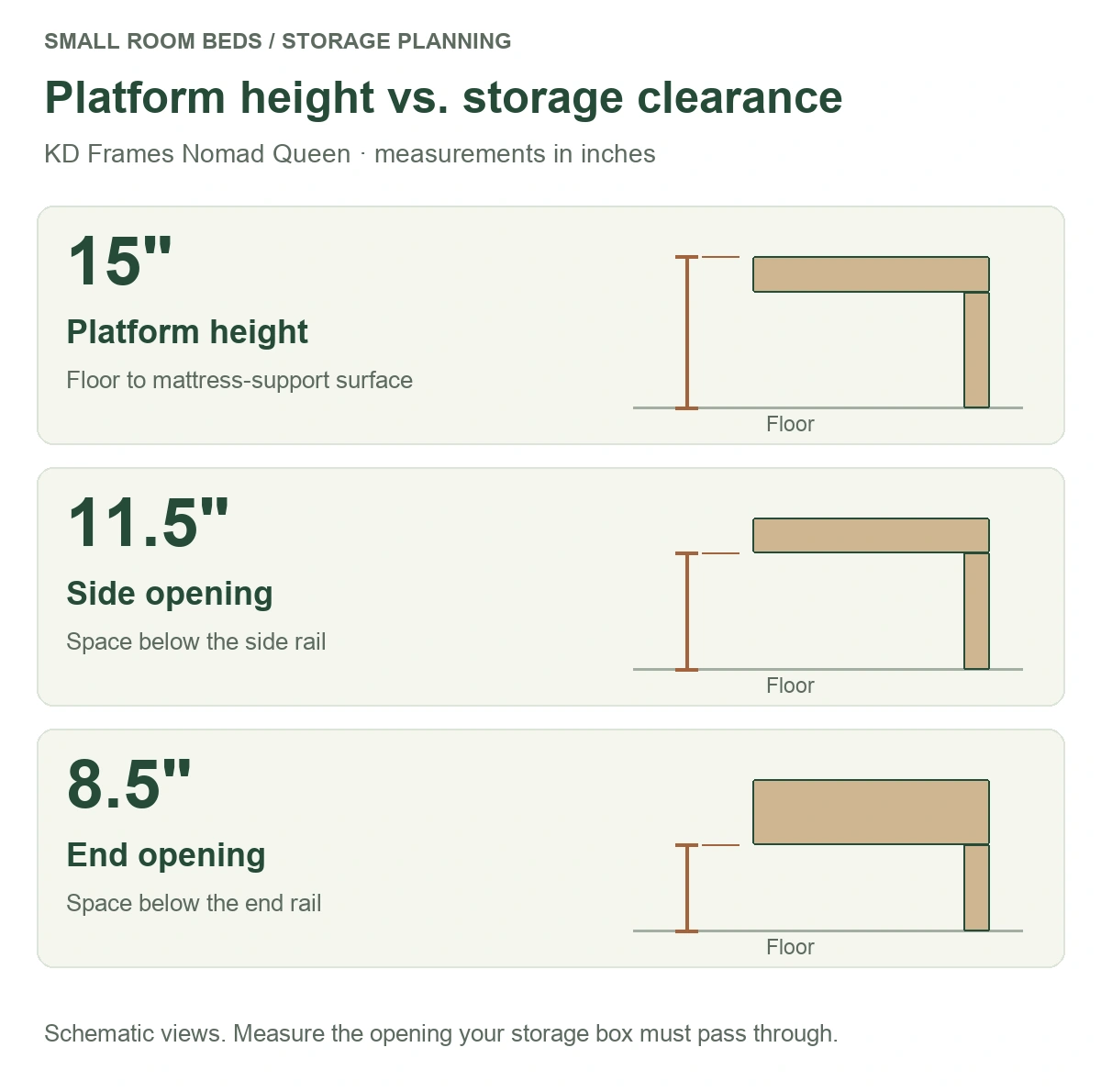
- 15 in platform; side opening 11.5 in and end opening 8.5 in
- Included features and setup
- No headboard; replaceable hardware
Why We Picked It
The Nomad is our starting choice for an uncomplicated wood platform that leaves room for the rest of your bedroom. Its headboard-free design keeps the perimeter narrow, while the slatted platform supports a compatible mattress without a separate box spring. Replacement hardware makes it a practical option if you expect to take the frame apart in the future.
KD Frames makes its frames in Athens, Georgia, using kiln-dried tulip poplar. The company describes the wood as coming from responsibly managed Virginia forests and says it applies no chemicals at its factory. The result is a smooth, unfinished surface for buyers who prefer a natural wood appearance.
The Queen measures 81.5 inches long and 60 inches wide, with a 15-inch platform height and 2.8-inch gaps between the slats. It gives you an 11.5-inch storage opening along the side, while the opening beneath the end rail is 8.5 inches high.
The combination of a narrow footprint, unfinished wood, and replaceable hardware makes the Nomad adaptable. You can pair it with the bedside furniture you already have and change the room’s style through bedding and lighting. It is especially appealing if you want a platform that can remain useful through more than one decorating scheme.
The finish is a matter of preference. Choose the Nomad if you enjoy light, exposed wood as it is. If you plan to stain or seal it, include that work and the chosen finish in your buying decision. Someone who wants a coordinated, finished headboard may prefer the Classic Queen instead.
Choose the Nomad for a bedroom where side access matters and a headboard is optional. A storage box that fits through the side may fail to pass underneath the lower end rail. If one long side sits against a wall and the other is blocked by a dresser, the advertised space beneath the bed may be difficult to use.
We would place frequently used storage toward the accessible side and keep the route clear of bedside furniture. For a bed positioned against a wall, plan that accessible side before buying your bins; the space under the far edge may be awkward to reach.
Pros
- Unfinished poplar with a specific account of its sourcing and manufacture.
- Narrow Queen footprint with no attached headboard.
- Replacement hardware and optional center legs are available.
Cons
- The plain frame leaves underbed items visible.
- The lower end rail restricts storage access from the foot.
Who Should Skip This
Skip this bed if you need a factory-finished headboard or retrieve tall bins from the foot. Compare Plank+Beam Classic for a finished wood headboard; plan its side storage access.
Before buying: compare the 2.8-inch slat gap with your mattress requirements. Check whether you need the maker’s optional center legs, and select any replacement hardware by model and production version.
2. Plank+Beam Classic Queen
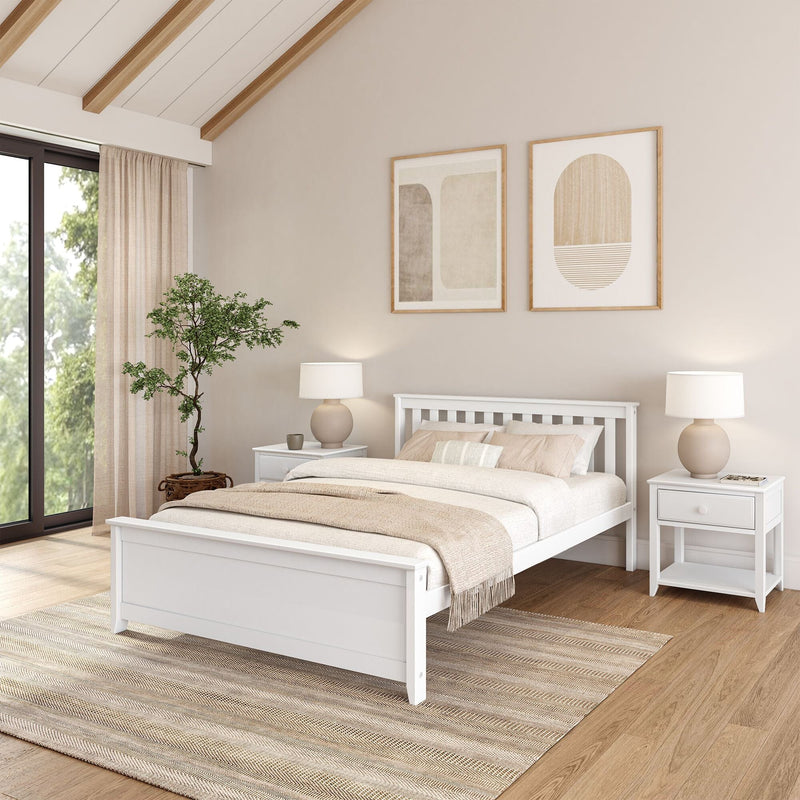
Queen · White · slatted headboard · 180312-002
We recommend Plank+Beam Classic Queen for its product-specific low-emissions certification.
Key Details
- Selected configuration
- Queen · White · slatted headboard · 180312-002
- Listed frame footprint (L × W)
- 85.5 × 64 in
- Frame and mattress support
- Solid pine, wood slats, metal center bar and three underbed legs
- Height and storage access
- 36.5 in headboard height; measure the platform and storage opening
- Included features and setup
- Included headboard and footboard; maker lists GREENGUARD Gold certification
Why We Picked It
The Classic Queen is our choice for a finished wood bed with a low-emissions certification and an included headboard. Plank+Beam lists this model as GREENGUARD Gold Certified. Its current design combines solid pine construction, wooden slats, a metal center-support bar, and three underbed support legs.
The Queen occupies 85.5 inches in length and 64 inches in width, with a 36.5-inch headboard height. It is a useful middle ground if you want the bed to look like a complete piece of furniture without the tall panel headboard of the Montauk.
The certification gives finish-conscious shoppers a concrete feature to compare. The matching frame and headboard also simplify the room: there is no separate headboard to source, mount, or align with the bed. White works well if you want the frame to blend with light walls while bedding supplies the color.
The open slats make the headboard visually lighter than a solid panel. That is helpful in a small bedroom where the bed sits directly in your sightline from the doorway. The footboard gives the opposite end a more enclosed appearance, so this still looks more substantial than a plain platform.
This is a stronger match for a room where the bed can remain against one wall and you have already measured the walkway at its foot. Compared with the Nomad, the Classic adds four inches to both the overall length and width. In a tight layout, mark that difference on the floor before deciding whether the more finished appearance is worth the space.
The panel footboard also affects how you reach underneath. Plan to remove storage from an accessible side rather than assuming a full-width opening at the foot. Measure the lowest point of that side opening, including any nearby support hardware, before buying bins.
A thick mattress and large pillows will cover more of the low headboard. Consider how much of it you want to see above your bedding. We would choose this frame for a room where its coordinated look is worth the extra perimeter, with enough space beside the bed to reach storage.
View the Classic Queen model details at Plank+Beam.
Pros
- The manufacturer lists the Classic Queen as GREENGUARD Gold Certified.
- A matching wood headboard is included.
- The open headboard keeps the design visually light.
Cons
- The headboard and footboard add to the occupied floor space.
- The panel footboard limits access beneath the bed from the end.
Who Should Skip This
Skip this bed if your foot passage cannot accommodate the extra length or an end board. Compare the Nomad for a narrower frame without end boards.
Before buying: confirm the support arrangement, weight capacity, and slat spacing of your selected version. Measure the side opening separately if you plan to reuse storage bins.
3. Zinus Ellie 14-Inch
Queen · Brown · Ellie 14-inch
We recommend Zinus Ellie 14-Inch for its close-fitting perimeter with 11-inch clearance.

Key Details
- Selected configuration
- Queen · Brown · Ellie 14-inch
- Listed frame footprint (L × W)
- 79.5 × 59.3 in
- Frame and mattress support
- Bamboo, plywood and steel; wood slats
- Height and storage access
- 14 in frame; 11 in listed clearance
- Included features and setup
- No headboard; direct support for a compatible mattress
Why We Picked It
The Ellie is our pick for a bamboo frame that keeps close to the mattress edge. With no attached headboard or wide decorative surround, it gives a small bedroom a straightforward outline. The Queen frame measures 79.5 inches long, 59.3 inches wide, and 14 inches high, with a listed 11 inches of underbed clearance.
Zinus describes the bamboo as sustainably manufactured and sourced. The complete materials list includes bamboo, plywood, and steel, making this a choice for buyers comfortable with a combination of materials. Wooden slats provide the mattress-support surface.
Ellie makes sense when you already have a workable Queen layout and want to avoid adding bulky furniture around it. It can sit beneath an existing wall-mounted headboard or leave the wall behind the pillows open. Its simple form also gives you more freedom to choose small bedside tables independently.
The frame dimensions are slightly smaller than a standard 60-by-80-inch Queen mattress. That does not turn the bed into a smaller sleeping area. For planning, use at least the mattress’s 80-by-60-inch boundary, then leave additional room for bedding and everyday movement. Measuring only the advertised frame would understate the space you need.
We would pair the Ellie with shallow storage that you can pull out from a clear side of the bed. Spare bedding and seasonal clothing are sensible uses when the closet is small. Measure the complete container, including its lid and handles, against the 11-inch opening.
Center supports divide the space underneath into smaller sections. Check the distance between them before buying a wide container, and leave enough room beside the bed to pull it out completely.
Leave space to lift and tuck bedding at the corners, too. A frame that closely follows the mattress can simplify furniture placement, but you still need to reach around the bed to change sheets. Check nearby outlets and baseboards before settling on the final position.
Pros
- A close-fitting perimeter suits an uncluttered Queen layout.
- The 11-inch underbed clearance offers room for low storage bins.
- The slatted platform supports a compatible mattress without a box spring.
Cons
- Includes plywood and steel, which will not suit an all-wood preference.
- No headboard is included.
Who Should Skip This
Skip this bed if you require an all-solid-wood structure without engineered support components. Compare the unfinished poplar Nomad and its specified slat system.
Before buying: confirm the maximum slat gap for your mattress and the space between the support legs for your storage containers.
4. Nectar Bamboo Bed
Queen · Natural · Bamboo Bed · frame only
We recommend Nectar Bamboo Bed for its tool-free frame connections.

Key Details
- Selected configuration
- Queen · Natural · Bamboo Bed · frame only
- Listed frame footprint (L × W)
- Approx. 84 × 64 in; confirm exact selected-version drawing
- Frame and mattress support
- Joinery-based bamboo frame with slatted support
- Height and storage access
- Confirm the usable underbed opening; not total frame height
- Included features and setup
- No included headboard; floating center-support arrangement
Why We Picked It
Nectar is our choice when tool-free assembly is high on your list. The Bamboo Bed uses a joinery-based design and a slatted mattress-support surface. In the Natural, frame-only configuration, it has a low outline with no attached headboard, making it easy to coordinate with the rest of the room.
Allow approximately 84 inches in length and 64 inches in width for initial room planning. The rails extend beyond the mattress, so leave that full rectangle clear when positioning a dresser or bedside table. The broader frame is an important difference from the close-fitting Ellie.
The assembly method is appealing if you expect to rearrange the room or take the bed apart for a move. The joinery connects the frame without tools, which is the main reason we would choose it over a conventional bolted platform. Compare the disassembly instructions and the size of the individual pieces with the route through your home.
The bamboo appearance and low frame can work well in a bedroom with simple furniture and little wall space for a large headboard. We would keep the bedside furniture similarly modest so that the frame remains the main wood element. You can add softness through pillows and bedding without enclosing more of the floor.
Consider Nectar for a bedroom where you have room for its broader rails and want a straightforward setup process. The key practical comparison with the Nomad is assembly preference versus floor space. If the room can spare the extra width and length, the joinery design may be more relevant to your needs than the narrowest frame.
Use the space at the sides for circulation before assigning it to storage. The rails need room beside them, and storage boxes need a clear pull-out path. If tall underbed bins are essential to your layout, confirm the entrance height before committing to this lower design.
For a future move, protect the joinery and keep the slat system together during packing. Photograph the connections before disassembly so you have a reference for the next setup. The value of tool-free construction is greatest when the pieces can also pass comfortably through your stairs and doorways.
Pros
- Tool-free assembly is useful for buyers who expect to dismantle the bed.
- The low, headboard-free design suits a simple bedroom scheme.
- An included slat system supports a compatible mattress without a box spring.
Cons
- Wider rails need more floor space than the Ellie or Nomad.
- A lower frame limits the height available for underbed storage.
Who Should Skip This
Skip this bed if your existing bins need a confirmed tall entrance or your side aisle is already tight. Compare the Ellie for a closer perimeter and specified clearance.
Before buying: use the exact model’s drawing for tight room clearances and check its slat spacing against your mattress requirements. Follow Nectar’s instructions for its floating center-leg arrangement during assembly.
5. Grain Wood Furniture Montauk
Queen · Driftwood · Montauk MT0324
We recommend Grain Wood Furniture Montauk for its rustic pine bed with a wood-sourcing statement.
Key Details
- Selected configuration
- Queen · Driftwood · Montauk MT0324
- Listed frame footprint (L × W)
- 84.5 × 64 in
- Frame and mattress support
- Solid pine bed; compatible separate foundation required
- Height and storage access
- 51 in headboard; foundation changes final sleeping height
- Included features and setup
- Included wood headboard and footboard; maker states FSC-certified wood
Why We Picked It
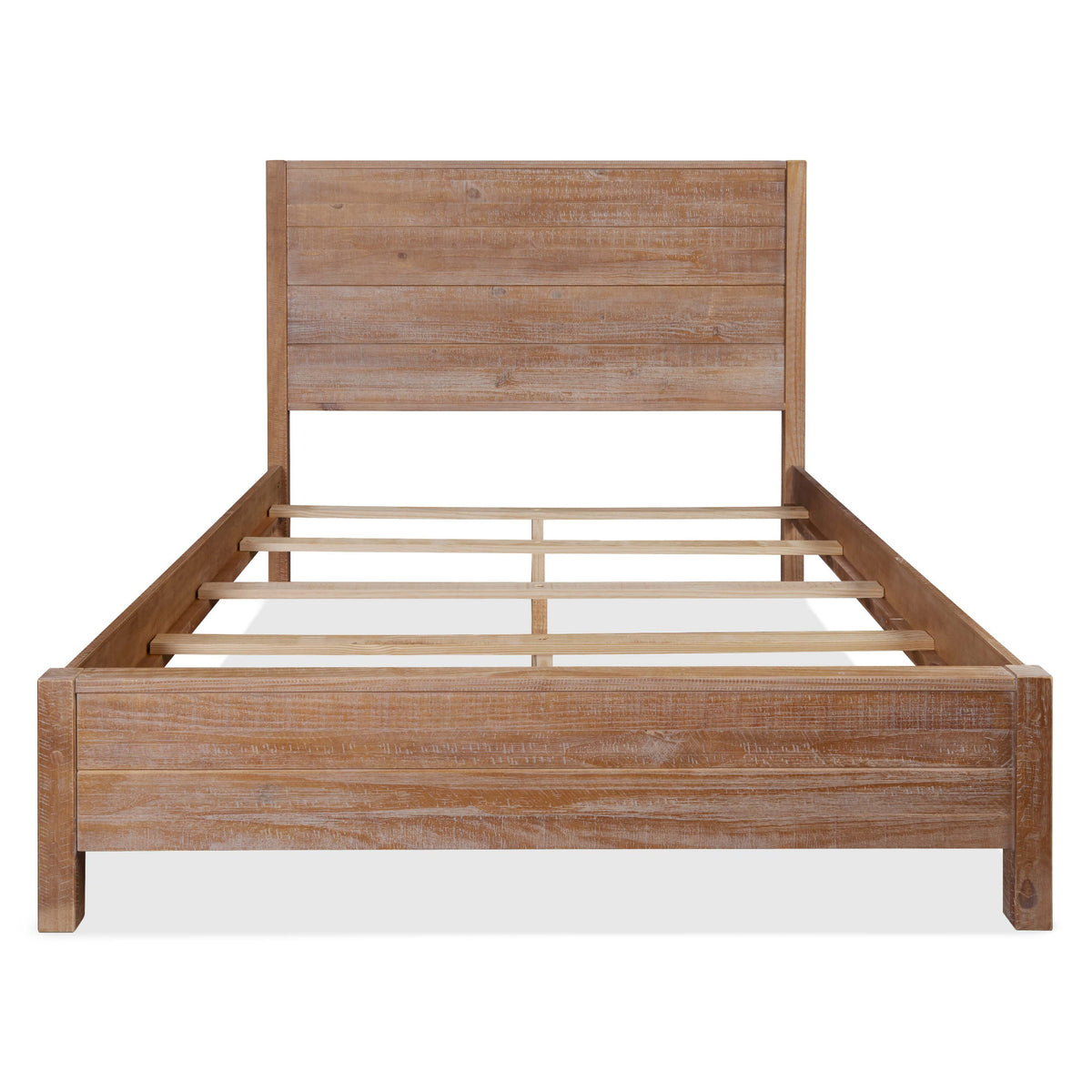
Montauk is our pick for a rustic bedroom built around a substantial wood bed. Its tall headboard, footboard, and distressed finish give it a different presence from the simpler platforms above. Grain Wood Furniture describes the bed as solid pine from renewable forests and states that it uses FSC-certified wood.
The Queen measures 84.5 inches long and 64 inches wide, with a 51-inch headboard height. That taller headboard is central to the look. Check its position against window sills, switches, and wall art as well as measuring the rectangle it occupies on the floor.
The grain, knots, and distressed appearance make the wood a prominent part of the room. If that is the style you want to keep, Montauk brings the headboard and frame together in one coordinated piece. Its explicit wood-sourcing statement is also useful for buyers who want more information about the material’s origin.
Its heavier visual presence can help organize a room with otherwise simple furnishings. You do not need the matching dresser and nightstands for the bed to work: keep the rest of the furniture proportional to the available space. Buying a complete set is less useful than preserving access to the closet and the side of the mattress.
Montauk suits a room that can comfortably accommodate both a headboard and a footboard. The Queen requires an additional mattress-support foundation. Grain Wood specifies a box spring and suggests a suitable bunkie board or low-profile box spring for a lower appearance.
That added component changes both the total cost and the finished bed height. Decide on the mattress and compatible foundation together. A lower foundation may help you reach the bed comfortably and keep more headboard visible, but it still needs to provide the support your mattress requires.
If you already own a compatible foundation in good condition, include it in your comparison. Keeping a useful component may make more sense for your setup than choosing a platform solely to eliminate an item you already have.
Pros
- Solid pine with a product-specific FSC wood statement.
- A coordinated headboard and footboard create a rustic look.
- Can work with an existing compatible foundation in good condition.
Cons
- The Queen needs a separate foundation, affecting cost and finished height.
- The tall headboard and footboard make handling and tight layouts less convenient.
Who Should Skip This
Skip this bed if your budget or preferred bed height leaves no room for a separate foundation. Compare Plank+Beam Classic for included slats, or Nomad for a plain platform.
Before buying: plan the foundation and mattress together, and check the combined sleeping height. The headboard’s back is semi-finished, so consider its visibility if you want to position the bed away from a wall.
How to Fit Your Bed Frame in a Small Bedroom
1. Mark the larger boundary: frame or mattress
A Queen label describes mattress compatibility, not the complete occupied area. Measure the larger of the mattress and frame in each direction, including the headboard and projecting legs. Use painter’s tape to mark that outline before delivery.
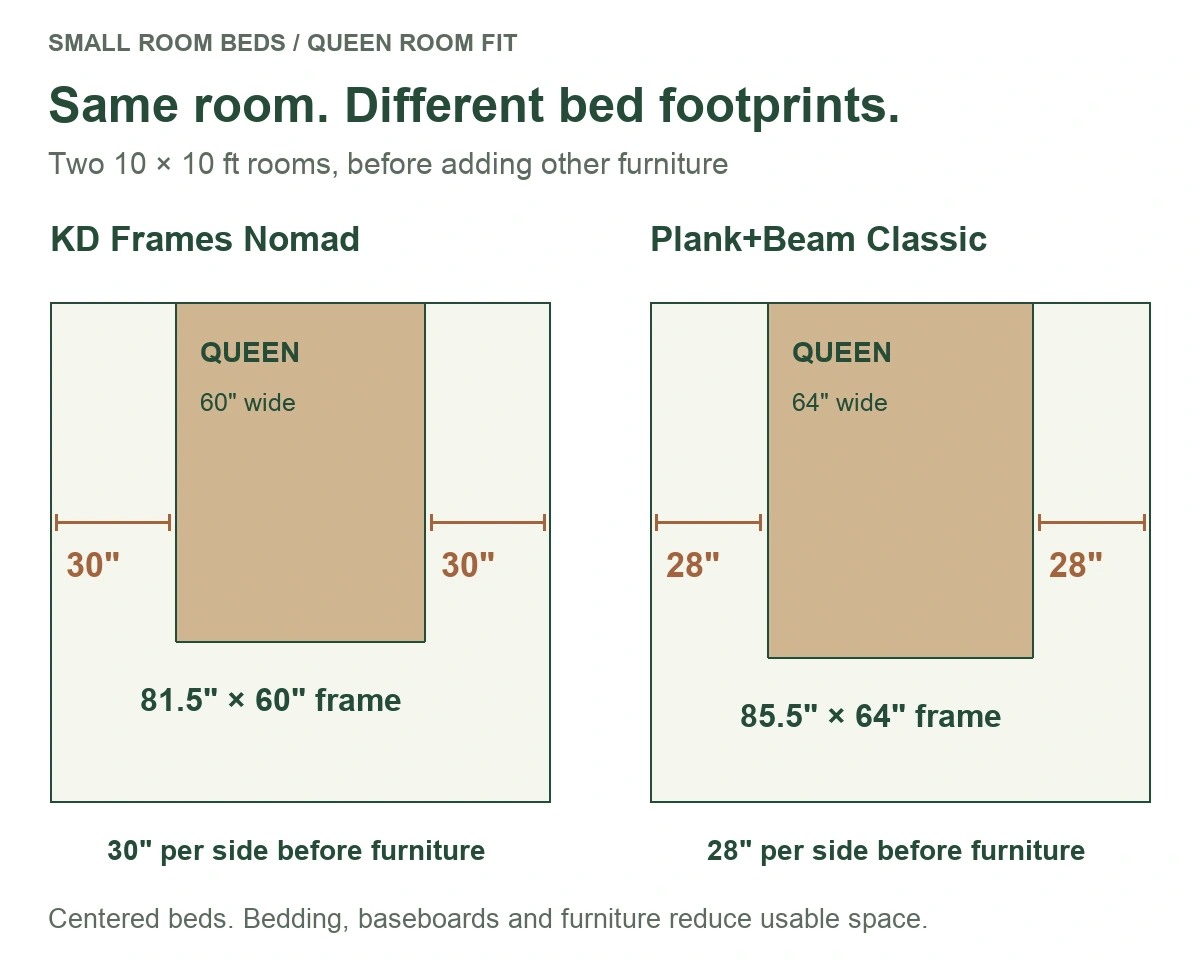
For example, in an otherwise empty 10-by-10-foot room, a centered 60-inch-wide bed leaves 30 inches on each side. A 64-inch-wide bed leaves 28 inches. Bedside tables, bedding, baseboards, and other furniture will reduce the usable space further.
The two-inch difference per side might be manageable in one layout and inconvenient beside a wardrobe in another. With the outline taped down, open the wardrobe, pull out the dresser drawers, and walk from the door to each side of the bed. If you are still deciding between mattress sizes, start with our bed size calculator and 10-by-10 bedroom guide.
2. Measure the route into underbed storage
Three dimensions matter: the height of the entrance, the unobstructed space behind it, and the space needed to pull a container out. Center legs can divide a wide opening into smaller usable sections. A bedside table can block a box even when the box fits perfectly beneath the rail.
For the Nomad, a 10-inch-tall container could pass through the side opening on height alone, but the lower end rail would block it at the foot. Plan which side you will use before filling the space with boxes. Keep frequently used items nearest that opening and reserve harder-to-reach areas for seasonal storage.
Leave room for the bin’s lid, handles, wheels, and your hands. A nominal measurement that just clears a rail may be inconvenient every time you need the contents. Use the assembled opening to make the final storage purchase.
3. Choose the foundation before setting the bed height
Settle the mattress-support arrangement before calculating how high the finished bed will be. The Montauk Queen needs an additional foundation, while the four platform-style choices supply slats. For each, check the mattress maker’s requirements for maximum gaps and center support.
If you already have a box spring or foundation, confirm that its type, dimensions, and condition suit the new frame and mattress. Reusing it should be a planned part of the setup. A component that made your old bed the right height may leave a different frame uncomfortably tall.
If an extra board is proposed, check its compatibility with both products, including any ventilation requirements. Treat a foundation as part of the planned system rather than an improvised fix after the bed arrives.
4. Work out the finished sleeping height
Add the height of the mattress-support surface, any separate foundation, and the mattress thickness. Do not start with the top of the headboard or the clearance beneath a side rail. Our bed height calculator can help organize those measurements.
As a planning example, a 15-inch support surface and a 12-inch mattress produce an uncompressed height of about 27 inches. Compare that figure with a bed you already find comfortable to get into and out of. Check your bedside-table height at the same time so a lamp, phone, or glass of water remains easy to reach.
5. Compare the complete setup cost
Compare the frame price together with any necessary foundation, support accessories, delivery, and assembly service. For a platform that works with your mattress as supplied, the frame may be most of the purchase. For Montauk, include a compatible foundation unless you already own one.
Use the same size and configuration when comparing offers. If you want a headboard, include its cost for a frame-only option and check how it will attach. If a headboard is unnecessary in your room, a simpler platform can keep the purchase focused on the features you will use.
Review the delivery and return terms for the seller you choose. In a small home, it also helps to plan where the boxes can sit during assembly and whether you have room to keep them until you have checked the delivered parts.
How to Keep Your Bed Frame Useful for Longer
Photograph the model label, save the receipt, and keep a copy of the assembly instructions. Store any spare hardware in a labeled bag with the model name. These small records make a future parts request easier than trying to identify a rail or fastener from memory.
Assemble on a protected surface with enough space to position the large pieces. Follow the manufacturer’s tightening order and support adjustments. If something will not align, revisit the previous steps before forcing a joint. A damaged connector can undermine a frame that otherwise suits the room well.
During use, follow the specified care and hardware-check instructions. Treat a new wobble or noise as a reason to inspect the assembly. For a sound frame with a loose or missing component, ask about the correct replacement part before deciding that the entire bed needs to go. Our no-squeak bed frame guide also explains why connection design and support details matter.
When moving, pack hardware by location and protect the joints and finished edges. Keep the instructions with the components. If you eventually pass the frame on, include those records so the next owner can assemble the correct version rather than guessing which parts belong where.
Frequently Asked Questions
Are bamboo bed frames always eco-friendly?
No. Look at sourcing information, the finish, and the complete materials list as well as the bamboo label. A bamboo frame can contain plywood or metal components. If low chemical emissions are your main priority, look for a certification that applies to the finished product.
Is unfinished wood better than a finished wood bed?
Unfinished wood suits buyers who like the natural surface or want to choose their own finish. A finished bed is convenient when you want a specific color and a coordinated headboard. Compare the care instructions and any emissions certification, and include the cost and work of finishing an unfinished frame if that is your plan.
Can an eco-friendly bed frame contain plywood?
Yes. Plywood may be used in the slats even when the visible rails are solid wood or bamboo. Consider its sourcing, any relevant emissions information, and how the support system matches your mattress. If you want to avoid engineered wood, check the slats and center components as well as the outer frame.
Do all five beds work without a box spring?
No. The Montauk Queen requires a separate foundation. The Nomad, Classic Queen, Ellie, and Nectar have slatted platforms for compatible mattresses. Check the instructions for your chosen size; the support requirements of a Twin can differ from those of a Queen in the same collection.
Which one is best if I expect to move?
Nectar is the first option to consider for tool-free assembly. The Nomad is another practical choice if replacement hardware is a priority. For either one, check the size of the disassembled pieces against your stairs and vehicle, and pack the joints and slats carefully.
Should I replace a bed I already own for an eco-friendly model?
If the current frame is sound, supports your mattress correctly, and fits the room, keeping it is worth considering. Check whether a loose or missing component can be replaced. A new frame makes more sense when it solves a support, space, or usability problem that repairs will not address.
Which Bed Frame Should You Choose?
The KD Frames Nomad is our best overall starting point for a simple wood platform with a narrow footprint and replacement hardware options. Choose the Plank+Beam Classic Queen if you want a finished headboard and a low-emissions certification. The Zinus Ellie keeps the bamboo frame close to the mattress, while Nectar is the stronger fit when tool-free assembly matters most. Montauk suits a rustic room with space for its headboard, footboard, and a separate foundation.
Before ordering, match the support system to your mattress and mark the full bed outline on your floor. Make sure you can reach your storage, open the furniture around the bed, and move comfortably through the room.